Gun Violence in American Indian and Alaska Native Communities
Guns have been a part of Native and Indigenous life on the North American continent since European colonizers first arrived in the 1600s.1 For tens of thousands of years, hundreds of thousands of people belonging to a multitude of tribes lived across what is now known as the US.2 But the arrival of European colonizers and their firearms ushered in centuries of violence and death.
The New Giffords Center for Violence Intervention Will Transform Public Safety
—Nov 17, 2022
In 1890 at the Wounded Knee Massacre, the US government shot and killed 300 Native people for participating in a spiritual tradition known as Ghost Dancing.3 This deadly incident epitomizes centuries of violence where Native and Indigenous peoples endured colonization, genocide, and forced removal from their ancestral lands—all of which firearms played a key part in perpetrating.2 These violent legacies have persisted over time, manifesting as historical trauma which contributes to the high rates of gun violence seen today in this community.4
However, firearms are also a source of cultural significance in Native and Indigenous communities. Many tribes rely on subsistence hunting as a main source of food and as a means of intergenerational teaching and learning.5 Some communities also use firearms in cultural practices.6
MEDIA REQUESTS
Our experts can speak to the full spectrum of gun violence prevention issues. Have a question? Email us at media@giffords.org.
Contact
Roughly 9.1 million American Indian and Alaska Native (AI/AN) people live in the US today.7 Many belong to one of the 575 federally recognized tribes.8 While most Native people identify more with the tribe to which they belong, collectively the most common term for the entire group is American Indian.9 The federal government uses the term American Indian and Alaska Native to also encompass Indigenous peoples of Alaska.
This memo will use data from the Centers for Disease Control and Prevention (CDC), which provides the most complete count of gun deaths among the AI/AN population. However, the counts provided by the CDC are almost certainly an undercount of the true scope of this problem. Studies have shown that deaths among American Indians and Alaska Natives are substantially underreported due to medical examiners misidentifying AI/AN identity on death certificates.10 Data on police shootings is pulled from Mapping Police Violence, a national nonprofit which uses police and media reports to track incidents of police violence.
On average, 474 American Indian and Alaska Natives die from gun violence each year. Nationally, gun death rates have fallen over the last five years, but these declines have not been felt equally across all communities. In act, the AI/AN gun death rate has remained stable over this period. In 2024, there were 2,550 fewer Black gun deaths than there were in 2020—an 18% decrease.11 However, the number of AI/AN gun deaths in 2024 was almost exactly the same as the number in 2020.12
Firearm Suicide
Half of all American Indian and Alaska Native gun deaths are gun suicides.13 The AI/AN community is disproportionate burdened by our nation’s suicide epidemic. The AI/AN firearm suicide rate is the second highest among all racial and ethnic groups, outpaced only by the firearm suicide rate among white people. 14
Young AI/AN people are disproportionately impacted by these suicides. In fact, American Indian and Alaska Native youth ages 10 to 24 make up 22% of the AI/AN community yet account for more than 26% of all suicide deaths.15 And when compared to other racial and ethnic groups, AI/AN children have the highest firearm suicide rate.16
There are also differences by gender for firearm suicide within the AI/AN community. From 2020 to 2024, the firearm suicide rate among AI/AN women decreased nearly 8% while the firearm suicide rate stayed the same for AI/AN men.17
Gun Suicide
A number of cultural forces are likely responsible for the stark disparities in AI/AN suicides compared to other groups. Pressure to acculturate, discrimination, and violence in the community—stemming from a legacy of historical trauma brought about by colonization, genocide, and relocation of Native peoples—have all been shown to contribute to suicides within this population.18 Additionally, AI/AN individuals face suicide risks that impact all communities,19 including friends and family members dying from suicide, alcohol and substance use, and feeling alienated from the community.20
Firearms also play an important and unique role in fueling suicides in AI/AN communities. Among all suicides in this country, more than half involve firearms—making firearms the most commonly used means of suicide.21 However, for AI/AN people, firearms are used in just 39% of all suicide deaths.22 This distribution, however, shows substantial variation by region and tribe.23 Of the 15 states with the largest proportions of AI/AN residents, guns were the most common means of AI/AN suicide in six.24 In Alaska, where one in seven residents identify as AI/AN, firearms are used in 42% of AI/AN suicides.25
Firearm Homicide
Nearly three in five AI/AN homicides are firearm homicides, and the AI/AN firearm homicide rate is more than four times higher than the gun homicide rate for non-Hispanic white people.26
Just as with firearm suicides, AI/AN firearm homicides vary by state and tribe. For example, in South Dakota where one in thirteen residents are AI/AN, the AI/AN firearm homicide rate is 11 times higher than the non-Hispanic white rate.27
A Devastating Toll: 2021 FBI Data Shows Guns Fueling Homicides
Oct 05, 2022
Young AI/AN people make up the majority of firearm homicide victims within this group, with more than one in four (26%) AI/AN gun homicide victims under the age of 25 and two in five (40%) under the age of 30.28 As seen in other demographic groups, AI/AN men are more likely to die in gun homicides than women. In fact, from 2003 to 2018, the firearm homicide rate among AI/AN men was three times higher than the rate among AI/AN women.29
However, firearm homicides among AI/AN people are often related to intimate partner violence, with roughly two in five firearm homicides among AI/AN women connected to intimate partner violence.30Survey data shows that more than half of all AI/AN women have experienced physical intimate partner violence, and more than two-thirds have experienced psychological aggression by an intimate partner.31 Firearms play a dangerous role in increasing the lethality of intimate partner violence.32 Alarmingly, guns are used in nearly half of all AI/AN intimate partner homicides.33
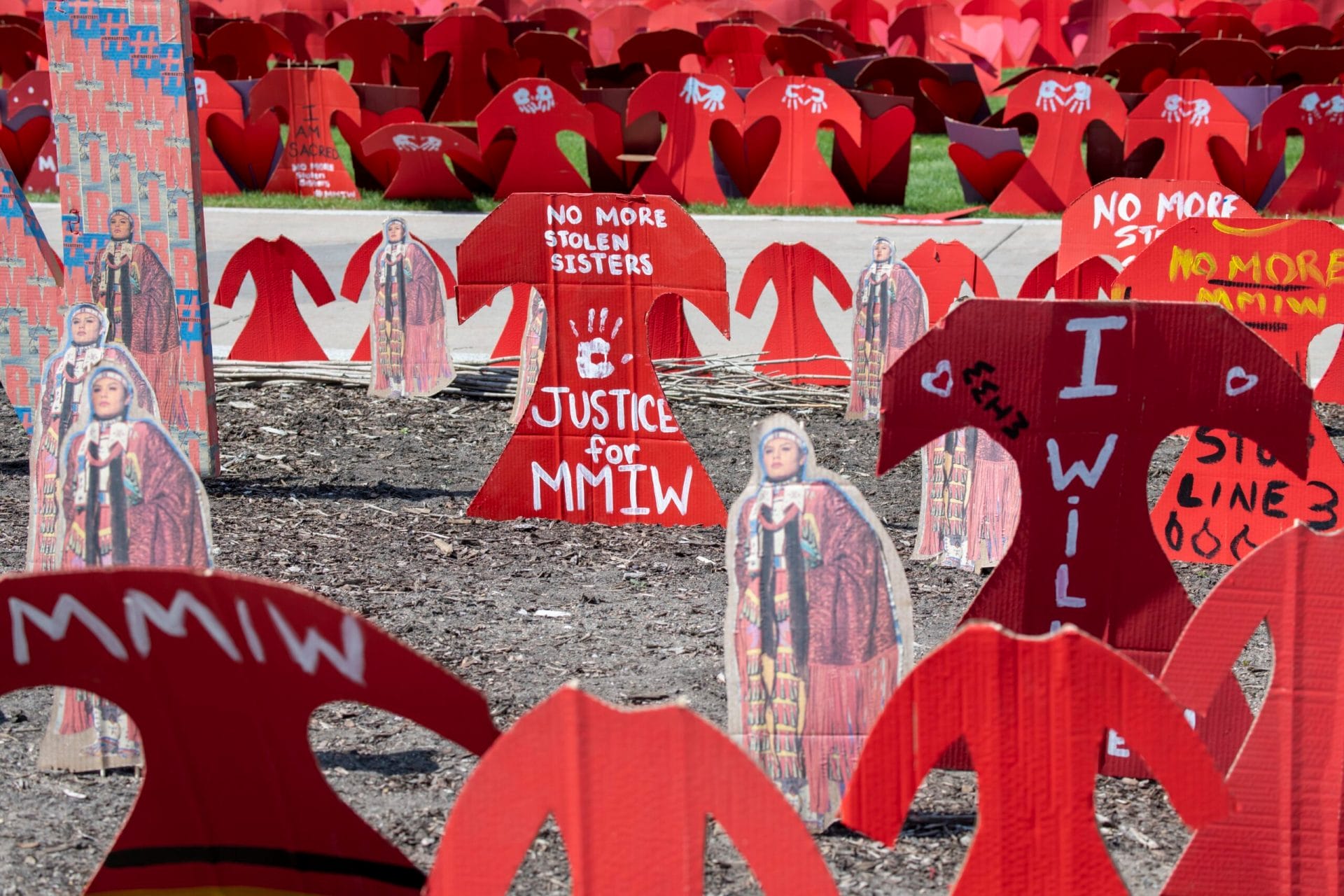
Available data also shows that AI/AN women experience intimate partner homicides and violence at disproportionate rates compared to other demographic groups,34 with AI/AN women dying in gun homicides at nearly three times the rate for non-Hispanic white women.35 In response to this stark disparity and to call attention to the problem, Native activists have been leading the Missing and Murdered Indigenous Women (MMIW) movement which seeks to raise awareness when Native women and girls are murdered or go missing.36
Police Shootings
Although AI/AN tribes are sovereign nations, AI/AN communities may be policed by several overlapping agencies including federal, state, county, municipal, and tribal law enforcement.37 In the areas surrounding reservations in particular, law enforcement has been shown to increasingly harass, surveil, and profile indigenous Americans at higher rates.38 This complex relationship between the AI/AN community and police creates an environment where AI/AN people are at significantly higher risk of violence by police, including police shootings. From 2020 to 2024, police shot and killed 83 AI/AN people.39In fact, AI/AN individuals were three times more likely to be shot and killed by law enforcement from 2015 to 2020.40
Importantly, however, these figures are likely an underestimate of the true toll of police violence in Native and Indigenous communities. Police shootings and killings of AI/AN people are significantly less likely to receive media coverage, with one study finding that of the 29 known Native people killed by police between May 2014 and October 2015, only two received any media coverage in the nation’s top 10 newspapers, with coverage of one of these shootings misidentifying the victim as Latino.41 Additionally, police shootings of AI/AN people are likely undercounted by federal data sources, both because of misclassification of race/ethnicity on death certificates and limited resources for tribes to collect and publish this data.42
POLICE VIOLENCE IS GUN VIOLENCE
We’ve signed on to a letter from the Community Justice Action Fund to demand accountability and stand in support of anti-racist action.
Gun violence is a devastating and all-too-frequent event in AI/AN communities—and it has been this way for far too long. Meaningful steps to prevent gun suicides, intimate partner violence, and police shootings are long overdue.
Culturally sensitive and community-led interventions represent one path forward for preventing gun violence and associated harms in AI/AN communities. These programs rely on community and tribal members to lead efforts to prevent gun suicides and other forms of gun violence, and engage with the many strengths of AI/AN communities including their strong sense of community, cultural identification, and spirituality.43 For example, multiple programs which provide safe storage counseling and access to safe storage devices in AI/AN communities have been found to lead to high numbers of people storing their firearms more safely44 and decreases in the number of guns stored unlocked.45
These interventions—coupled with proven gun safety laws—can help reduce the toll of gun violence and keep AI/AN communities safe.
JOIN THE FIGHT
Nearly 47,000 Americans lose their lives to gun violence every year. GIFFORDS Law Center is leading the fight to save lives by championing gun safety policies and holding the gun lobby accountable. Will you join us?
- David J. Silverman, “Guns, Empire and Indians,” Aeon, October 13, 2016, https://aeon.co/essays/how-did-the-introduction-of-guns-change-native-america.[↩]
- “Native American,” Library of Congress, last accessed September 26, 2022, https://www.loc.gov/classroom-materials/immigration/native-american/.[↩][↩]
- Allen Salway, “Gun Violence Has a Major Impact on Native Communities in the United States,” Teen Vogue, June 14, 2018, https://www.teenvogue.com/story/gun-violence-has-a-major-impact-on-native-communities-in-the-united-states; “Disaster at Wounded Knee,” Library of Congress, last accessed September 26, 2022, https://www.loc.gov/classroom-materials/immigration/native-american/disaster-at-wounded-knee/; “Dec. 29, 1890: Wounded Knee Massacre,” Zinn Education Project, last accessed September 26, 2022, https://www.zinnedproject.org/news/tdih/anniversary-of-the-wounded-knee-massacre-2/.[↩]
- Tony V. Pham et al., “Suicide Interventions for American Indian and Alaska Native Populations: A Systematic Review of Outcomes,” SSM – Mental Health 1 (2021): 100029, https://www.sciencedirect.com/science/article/abs/pii/S0277953614000707?via%3Dihub.[↩]
- Catherine E. Burnette, Caro B. Clark, and Christopher B. Rodning, “’Living Off the Land’: How Subsistence Promotes Well-being and Resilience Among Indigenous Peoples of the Southeastern United States,” Social Service Review 92, no. 3 (2018): 369–400; Lisa Wexler et al., “Describing Meanings and Practices Related to Firearms, Safety, and Household Storage in Rural Alaska Native Communities,” Journal of Rural Mental Health (2022).[↩]
- Lisa Wexler et al., “Describing Meanings and Practices Related to Firearms, Safety, and Household Storage in Rural Alaska Native Communities,” Journal of Rural Mental Health (2022).[↩]
- US Census Bureau, “DP05 ACS DEMOGRAPHIC AND HOUSING ESTIMATES,” American Community Survey 1-Year Estimate Data Profiles, 2024, https://data.census.gov/table/ACSDP1Y2024.DP05?q=American+Indian+and+Alaska+Native.[↩]
- U.S. Department of the Interior Indian Affairs, “Tribal Leaders Directory,” Division of Tribal Government Services, last accessed, August 4, 2026, https://www.bia.gov/service/tribal-leaders-directory.[↩]
- National Museum of the American Indian, “Teaching & Learning about Native Americans,” Smithsonian, last accessed September 26, 2022, https://americanindian.si.edu/nk360/faq/did-you-know.[↩]
- Jiaquan Xu et al., “Deaths: Final Data for 2019,” National Vital Statistics Reports 70, no. 8 (2021), https://stacks.cdc.gov/view/cdc/106058/cdc_106058_DS1.pdf; Elizabeth Arias et al., “The Validity of Race and Hispanic Origin Reporting on Death Certificates in the United States,” Vital and Health Statistics 2, no.148 (2008), https://www.cdc.gov/nchs/data/series/sr_02/sr02_148.pdf.[↩]
- In 2020, there were 13,974 total non-Hispanic Black gun deaths. In 2024, there were 11,424 total non-Hispanic gun deaths. Centers for Disease Control and Prevention, Wide-ranging Online Data for Epidemiologic Research (WONDER), “Underlying Cause of Death, 2018-2024, Single Race,” last accessed May 20, 2026, https://wonder.cdc.gov/.[↩]
- In 2020, there were 449 total non-Hispanic AI/AN gun deaths. In 2024, there were 442 total non-Hispanic AI/AN gun deaths. Id.[↩]
- From 2020 to 2024, there were 2,369 total non-Hispanic AI/AN gun deaths and 1,178 non-Hispanic AI/AN firearm suicides. Id.[↩]
- From 2020 to 2024, the age-adjusted non-Hispanic AI/AN firearm suicide rate was 9.48 per 100,000. From 2020 to 2024, the age-adjusted non-Hispanic white firearm suicide rate was 9.61 per 100,000. Id.[↩]
- From 2020 to 2024, there were 798 total suicides among non-Hispanic AI/AN youth ages 10 to 24 years old. During the same time period, there were 3,052 total suicides among the entire non-Hispanic AI/AN population. During that time period there were 2,655,471 AI/AN youth ages 10 to 24 years old and 12,180,375 total AI/AN. Id. [↩]
- From 2020 to 2024, the firearm suicide rate for AI/AN children ages 10 to 17 was 5.64 per 100,000. The next highest firearm suicide rate for children ages 10 to 17 was among non-Hispanic white children at 2.80 per 100,000. Id.[↩]
- In 2020, the age-adjusted female non-Hispanic AI/AN firearm suicide rate was 2.20 per 100,000 and in 2024 the rate was 2.03 per 100,000. In 2020, the age-adjusted male non-Hispanic AI/AN firearm suicide rate was 15.91 per 100,000 and in 2024 the rate was 15.62 per 100,000—a less than 2% decrease. Id.[↩]
- Tony V. Pham et al., “Suicide Interventions for American Indian and Alaska Native populations: A Systematic Review of Outcomes,” SSM – Mental Health 1 (2021); Raul Caetano et al., “Suicide, Alcohol Intoxication, and Age Among Whites and American Indians/Alaskan Natives,” Alcoholism: Clinical and Experimental Research 44, no. 2 (2020): 492–500; Mark S. Kaplan, “Acute Alcohol Intoxication and Suicide: a Gender-stratified Analysis of the National Violent Death Reporting System,” Injury Prevention 19, no. 1 (2013): 38–43.[↩]
- “Suicide Prevention Risk and Protective Factors,” Centers for Disease Control and Prevention, last accessed September 26, 2022, https://www.cdc.gov/suicide/factors/index.html.[↩]
- Tony V. Pham et al., “Suicide Interventions for American Indian and Alaska Native Populations: A Systematic Review of Outcomes,” SSM – Mental Health 1 (2021).[↩]
- From 2020 to 2024, 55% of suicides in the US involved firearms. Centers for Disease Control and Prevention, Wide-ranging Online Data for Epidemiologic Research (WONDER), “Underlying Cause of Death, 2018-2024, Single Race,” last accessed May 20, 2026, https://wonder.cdc.gov/.[↩]
- Based on an average of the five most recent years of available data: 2020 to 2024. Id.See also, Deborah Stone et al., “Suicides Among American Indian or Alaska Native Persons — National Violent Death Reporting System, United States, 2015-2020,” Morbidity and Mortality Weekly Report, no. 71 (2022): 1161-1168[↩]
- “Suicide Clusters within American Indian and Alaska Native Communities: A Review of the Literature and Recommendations,” Substance Abuse and Mental Health Services Administration, HHS Publication No. SMA17-5050, 2017, https://store.samhsa.gov/sites/default/files/d7/priv/sma17-5050.pdf.[↩]
- The fifteen states with the highest AI/AN population are Alaska, Arizona, California, Colorado, Idaho, Kansas, Montana, Nevada, New Mexico, North Dakota, Oklahoma, Oregon, South Dakota, Washington, and Wyoming.Based on an average of the five most recent years of available firearm suicide data: 2020 to 2024. Centers for Disease Control and Prevention, Wide-ranging Online Data for Epidemiologic Research (WONDER), “Underlying Cause of Death, 2018-2024, Single Race,” last accessed May 20, 2026, https://wonder.cdc.gov/.[↩]
- Between 2020 and 2024, AI/AN residents of Alaska made up 15% of the population. Id.[↩]
- From 2020 to 2024, there were 984 non-Hispanic AI/AN firearm homicides and 1,690 total homicides. The age-adjusted non-Hispanic AI/AN firearm homicide rate was 8.28 per 100,000 compared to the age-adjusted non-Hispanic white firearm homicide rate of 2.02 per 100,000. Id. [↩]
- From 2020 to 2024, the age-adjusted non-Hispanic AI/AN firearm homicide rate in South Dakota was 14.31 per 100,000. The age-adjusted non-Hispanic white firearm homicide rate during the same period in the state was 1.29per 100,000. Id.[↩]
- From 2020 to 2024, there were 984 total non-Hispanic AI/AN gun homicides. During the same time period there were 254 gun homicides among non-Hispanic AI/AN individuals ages 0 to 24. During the same time period there were 140 gun homicides among non-Hispanic AI/AN individuals ages 25 to 29. Id.[↩]
- Emiko Petrosky et al., “Homicides of American Indians/Alaska Natives — National Violent Death Reporting System, United States, 2003–2018,” MMWR Surveillance Summaries 70, no. SS-8, (2021): 1–19, https://www.cdc.gov/mmwr/volumes/70/ss/ss7008a1.htm.[↩]
- Id.[↩]
- “Five Things About Violence Against American Indian and Alaska Native Women and Men,” National Institute of Justice, US Department of Justice, May 2016, https://www.ojp.gov/pdffiles1/nij/249815.pdf. See also, “Violence Against Native Peoples fact sheet,” Center for Disease Control and Prevention, (n.d.), last accessed September 27, 2024, https://www.cdc.gov/injury-tribal/media/pdfs/Violence-Against-Native-Peoples-Fact-Sheet.pdf. [↩]
- J.C. Campbell et al., “Risk Factors for Femicide in Abusive Relationships: Results from a Multisite Case Control Study,” American Journal of Public Health 93, no.7 (2003): 1089–1097.[↩]
- Emiko Petrosky et al., “Racial and Ethnic Differences in Homicides of Adult Women and the Role of Intimate Partner Violence — United States, 2003–2014,” Morbidity and Mortality Weekly Reports 66, (2017): 741-746, https://www.cdc.gov/mmwr/volumes/66/wr/mm6628a1.htm.[↩]
- Michael O. Maume et al., “Social Isolation and Weapon Use in Intimate Partner Violence Incidents in Rural Areas,” International Journal of Rural Criminology 2, no. 2 (2014); Ronet Bachman et al., “Violence Against American Indian and Alaska Native Women and the Criminal Justice Response: What Is Known,” US Department of Justice, August 2008, https://www.ojp.gov/pdffiles1/nij/grants/223691.pdf; Kaitlin Forsberg et al., “Racial/Ethnic Differences in Homicides of Adult Women and the Role of Intimate Partner Violence: United States, 2018–2022,” American Journal of Public Health 116, no. 6 (2026): 829-840.[↩]
- From 2020 to 2024, the age-adjusted AI/AN gun homicide rate for women was 3.15 per 100,000. During the same time period, the age-adjusted non-Hispanic White gun homicide rate for women was 1.11 per 100,000. Centers for Disease Control and Prevention, Wide-ranging Online Data for Epidemiologic Research (WONDER), “Underlying Cause of Death, 2018-2024, Single Race,” last accessed May 20, 2026, https://wonder.cdc.gov/.[↩]
- “The Search for Jermain & The Epidemic of Missing & Murdered Indigenous Women,” KALW, May 27, 2021, https://www.kalw.org/show/your-call/2021-05-27/the-search-for-jermain-the-epidemic-of-missing-murdered-indigenous-women; 1A, “The Search For Missing And Murdered Indigenous Women,” NPR, August 25, 2020, https://www.npr.org/2020/08/20/904292782/the-search-for-missing-and-murdered-indigenous-women; “MMIWG2S,” Coalition to Stop Violence Against Native Women, last accessed October 3, 2022, https://www.csvanw.org/mmiw/.[↩]
- Gabriel L. Schwartz, Theresa Rocha Beardall, Jaquelyn L. Jahn, “Heightened risk of fatal police violence in and around reservations for American Indian/Alaska Native peoples in the United States,” Proceedings of the National Academy of Sciences 123, no. 11 (2026): e2521002123.[↩]
- Id.[↩]
- Mapping Police Violence uses Native American to identify this racial group. AI/AN was substituted here for consistency with other sections of this memo. Mapping Police Violence, “National Trends,” last accessed May 26, 2026, https://mappingpoliceviolence.squarespace.com/.[↩]
- Elle Lett, et al., “Racial inequality in fatal US police shootings, 2015-2020,” Journal of Epidemiology & Community Health, no. 75 (2021): 394-397. See also, Vageesh Jain, David Hemenway, “Firearm Homicides by Police in the United States: Who is Shot and How Many Times?” American Journal of Preventive Medicine 68, no. 5 (2025): 982-988.[↩]
- Jean Reith Schroedel and Roger J. Chin, “Whose Lives Matter: The Media’s Failure to Cover Police Use of Lethal Force Against Native Americans,” Race and Justice 10, no. 2 (2020): 150–175.[↩]
- Jerreed D. Ivanich, “Fatal police violence near reservations: Interpreting risk in context,” Proceedings of the National Academy of Sciences 123, no. 17 (2026):e2607272123.[↩]
- Tony V. Pham et al., “Suicide Interventions for American Indian and Alaska Native Populations: A Systematic Review of Outcomes,” SSM – Mental Health 1 (2021); Catherine E. McKinley et al., “Community-engaged and Culturally Relevant Research to Develop Behavioral Health Interventions with American Indians and Alaska Natives,” American Indian and Alaska Native Mental Health Research 26, no. 3 (2019).[↩]
- A. Horn et al., “Community based program to improve firearm storage practices in rural Alaska,” Injury Prevention 9, (2003): 231-234.[↩]
- David C. Grossman et al., “Improving Firearm Storage in Alaska Native Villages: A Randomized Trial of Household Gun Cabinets,” American Journal of Public Health 102, no. S2, (2012): S291-S297.[↩]