2025 Community Violence Intervention Legislation Year in Review
This past year was one of pressure, uneven progress, and state-level decision-making.
In 2025, the field of community violence intervention faced strong headwinds. A new presidential administration oversaw the Department of Justice’s elimination of more than $811 million worth of public safety grants, including $150 million previously awarded to CVIPI grantees. These cuts carved into funding streams that had been part of historic, bipartisan legislation and created sudden gaps for community-based programs. They also put significant pressure on states to decide whether and how they would step in.

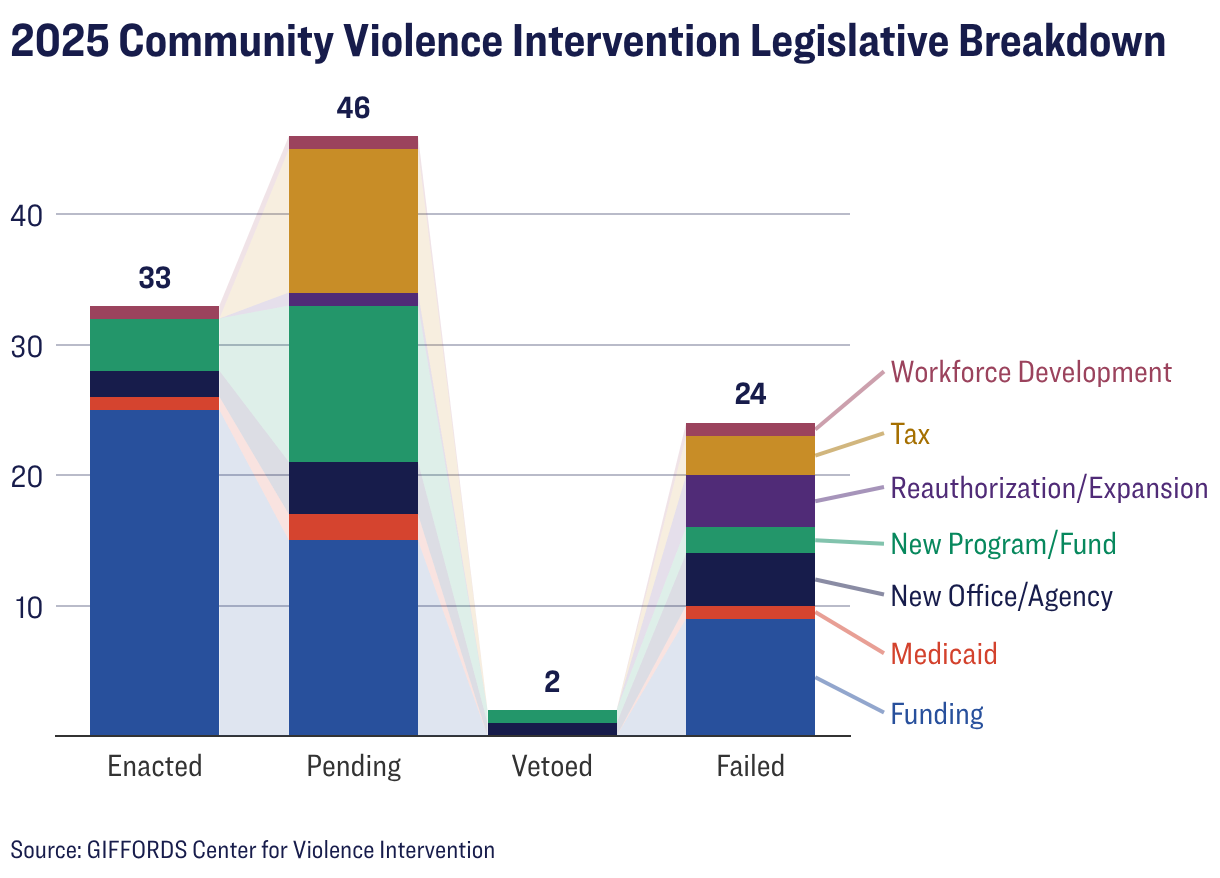
Against that backdrop, GIFFORDS tracked the movement of 105 CVI-related bills across 27 states and Washington DC.1 Even amid shifting political and fiscal landscapes, a number of states met the moment by continuing to recognize the importance of addressing gun violence through community-based, public health approaches. Others struggled to do so, underscoring how uneven state-level commitment remains.
The largest category of enacted legislation, which included 25 bills, focused on directly funding CVI work through state appropriations. In total, 22 states contributed over $497 million to CVI efforts in 2025. While substantial, this progress also highlights the stakes. In 2017, just five states invested $70 million in CVI programs, and today’s growth reflects years of advocacy colliding with an increasingly fragile federal safety net.
As federal priorities shift, states face increasing pressure to determine their own level of commitment to violence intervention efforts. To track how states are responding in real time, explore CVI-PATH, our legislative tracker for updates and analysis on where momentum is building and where gaps remain.
In 2025, state governments played an increasingly visible role in shaping violence intervention and prevention efforts by building infrastructure and expanding administrative capacity. These developments underscore how state policy and planning are influencing the direction of community-driven approaches in a shifting national landscape. Below are noteworthy highlights from the year:
- Twenty-two states appropriated more than $497 million through legislation to support CVI initiatives nationwide. New violence prevention funding was enacted in Texas (SB 1) and Nebraska (LB 261), joining South Carolina and Florida to demonstrate growing bipartisan momentum for these initiatives across traditionally conservative states.
- Last year, a record 14 bills were introduced in 7 states and Washington DC to create stable funding streams by creating or redirecting sales taxes, taxes on cannabis and hemp, or taxes on firearms and ammunition. This follows Colorado’s successful passage of Proposition KK in 2024 and California’s AB 28, which passed in 2023 and took effect last year. Illinois (SB 20, HB 1023), Massachusetts (SB 1652, HB 3082), Maryland (HB 387), Michigan (H 4260, H 4231), New York (SB 5813, SB 1315, AB 6024), Virginia (HB 2558), Washington (HB 1386), and Washington DC (B 51) each proposed similar legislation this year, though none have been enacted to date.
- Twelve states and Washington DC introduced legislation for new grant programs to distribute funds to violence intervention efforts. Four states were successful: Massachusetts (HB 4240) created a competitive grant program within the Department of Public Health; Michigan (HB 4706) dedicated funds to create a grant program with the Department of Health and Human Services; South Carolina (H 4025) tasked the Department of Health with establishing the Community Violence Intervention and Prevention Program; and Texas established a state-funded Project Safe Neighborhoods Program within the Governor’s Office of Trusteed Programs.
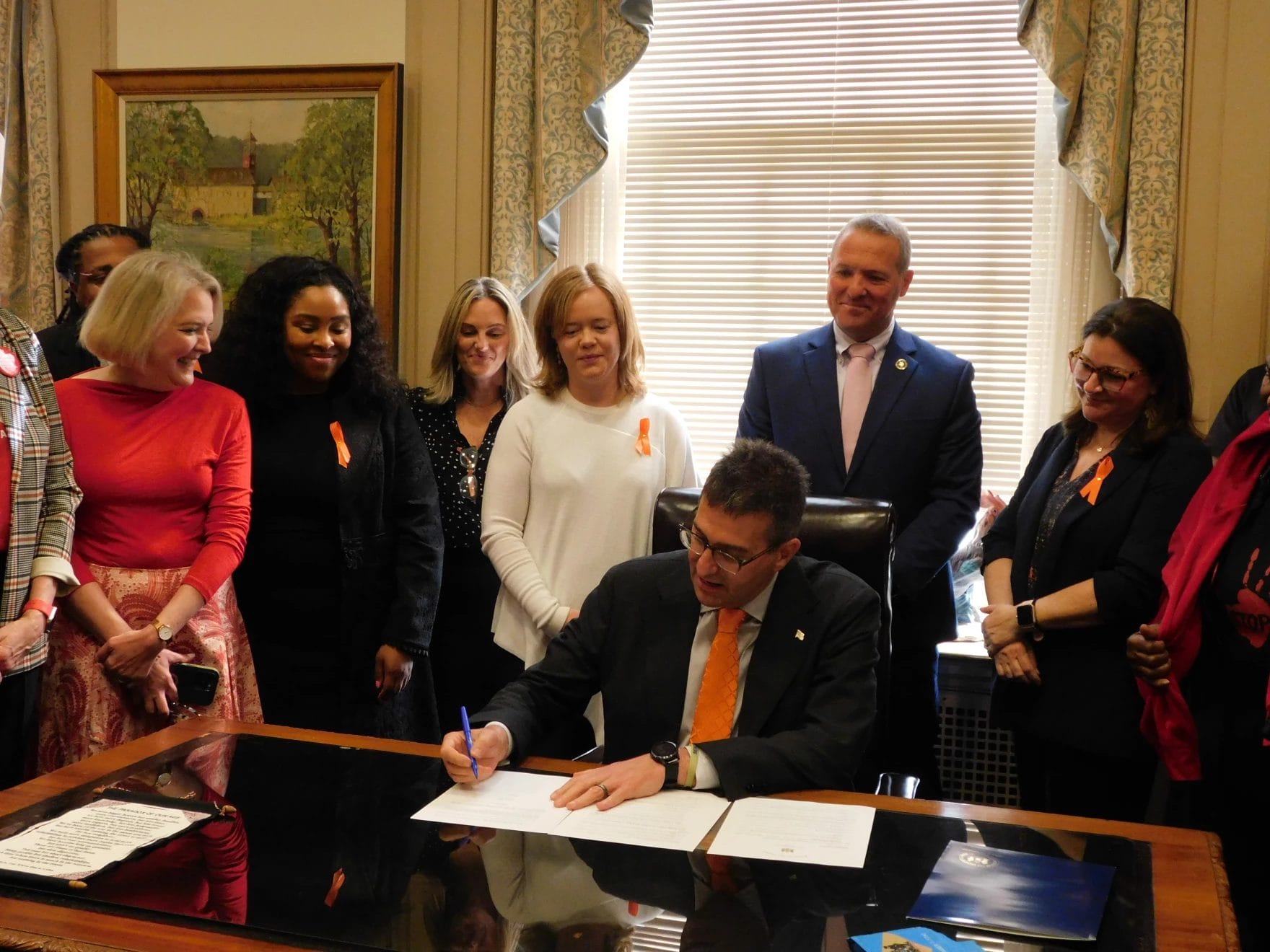
- Nine states and Washington DC introduced bills creating an Office of Violence Prevention (OVP) or equivalent department. This year, New York codified its Office of Gun Violence Prevention within the Division of Criminal Justice Services, and the governors of Delaware and Wisconsin signed executive orders to establish similar offices. The Virginia legislature also passed a bill that would have created an office akin to an OVP; however, it was vetoed by the governor. In total, 17 states have established OVPs through legislative or executive action.
- Three states introduced legislation to allow Medicaid reimbursement for violence intervention and prevention professionals. Michigan (HB 6046) was the sole state to enact this policy, specifying that community violence prevention services will now be covered under the community health worker benefit. Michigan joins 10 other states that have enabled reimbursement for these services through Medicaid, though concerns around an unsupportive federal administration, costs, and implementation remain challenges that will require concerted advocacy to overcome.
Several jurisdictions stepped up efforts to address community violence in 2025, enacting bold legislation and doubling down on proven solutions. Through dedicated funding streams, new programs, and innovative strategies, these states demonstrated how government can effectively partner with communities to prevent violence. Their achievements reflect a growing recognition that community-driven approaches are essential for public safety.
ILLINOIS
When federal Immigration and Customs Enforcement activity increased across Illinois, the deep networks of community-based organizations that have long worked to promote safety, trust, and resilience across neighborhoods responded. In Chicago, entities such as Scaling Community Violence Intervention for Safer Chicago (SC2), Chicago CRED, Metropolitan Peace Initiatives, and dozens of frontline outreach organizations mobilized with training, mutual aid, “know your rights” education, and rapid response efforts to support vulnerable residents. This holistic approach, grounded in collaboration across government agencies and trusted community partners, extends beyond gun violence reduction to serve as a backbone for protecting and empowering all residents in moments of crisis.
MICHIGAN
Michigan took several critical steps to advance CVI priorities this year. Starting off the year strong, the state expanded Medicaid (HB 6046) to reimburse providers of violence prevention services in January. Then, in the fall, enacted two bills (HB 4706, SB 166) providing over $15 million dollars to CVI efforts, one of which also establishes a CVI grant program within the state’s Department of Health and Human Services.
Nebraska
Nebraska (LB 261) took a modest but meaningful step toward improving public safety with a $1.6 million investment over two years in the state’s Office of Violence Prevention. The OVP focuses on the reduction of street or gang violence, homicide injuries caused by firearms, and supporting youth employment opportunities in high-crime areas. Nebraska joins a growing list of traditionally conservative states adopting CVI policies alongside Florida, South Carolina, and Texas.
TEXAS
Texas took a historic step toward addressing community violence by appropriating $2 million over two years in the state budget to fund CVI efforts for the first time. This new funding, housed within the Governor’s Office of Trusteed Programs, is intended to provide essential support to local governments, nonprofit organizations, and community-based partnerships. Advocates and CVI groups also continued to push for the establishment of a CVI-focused grant program and an office of violence prevention, though these efforts were unsuccessful this year.
WASHINGTON
Washington State took an important step toward supporting the CVI field by passing SB 5167, which, in addition to dedicating more than $28 million over two years to support violence intervention, establishes a state-funded program to train and certify frontline workers. The initiative aims to expand culturally responsive violence intervention and prevention services across at least three regions in the state. Washington joins California and Pennsylvania as one of the few states directly investing in frontline worker wellness, professional development, and technical training.
STAY CONNECTED
Interventions are most effective when they are supported by strong community networks. Sign up for Giffords Center for Violence Intervention’s newsletter to learn more about what’s happening in the field, relevant legislation, and funding opportunities.
As we enter 2026, several opportunities to advance community violence intervention efforts remain, from pending legislation that would generate revenue for CVI by taxing firearms and ammunition in Massachusetts (SB 1652, HB 3082) to efforts that create local CVI programs in red states like Florida (SB 702, HB 155). At the same time, uncertainty surrounding federal funding and limited prospects for new national investments place increasing responsibility on states to sustain and expand this work.
Across the country, we are seeing cities with strong CVI infrastructure—such as Los Angeles, Baltimore, and Chicago—reporting record low homicide rates, reinforcing that community-led strategies are effective when they are supported over time. Continued state commitment will be critical to preserving these reductions, enhancing public safety, and protecting against further erosion of the progress communities have fought to achieve.
SPOTLIGHT
TRACKING CVI LEGISLATION
Community violence intervention is a crucial approach to fighting gun violence. Keep up to date on the latest CVI legislation in your state with the Giffords Community Violence Intervention Policy Analysis & Tracking Hub—CVI-PATH.
Read More
- Includes enacted, failed, introduced, pending, passed first chamber, prefiled, sent to governor, and vetoed.[↩]