Gun Law Trendwatch: The Dangerous Push to Expand Access to Guns in State Capitols
Guns in democratic spaces are a safety risk. But some lawmakers just don’t care.
A growing national divide is emerging over whether guns should be permitted inside state capitols and other core democratic institutions.
The January 6, 2021, attack on the United States Capitol laid bare how the presence of firearms can escalate political unrest into deadly violence. But it’s not the only time in recent history that’s illustrated just how necessary firearm restrictions in democratic spaces are.
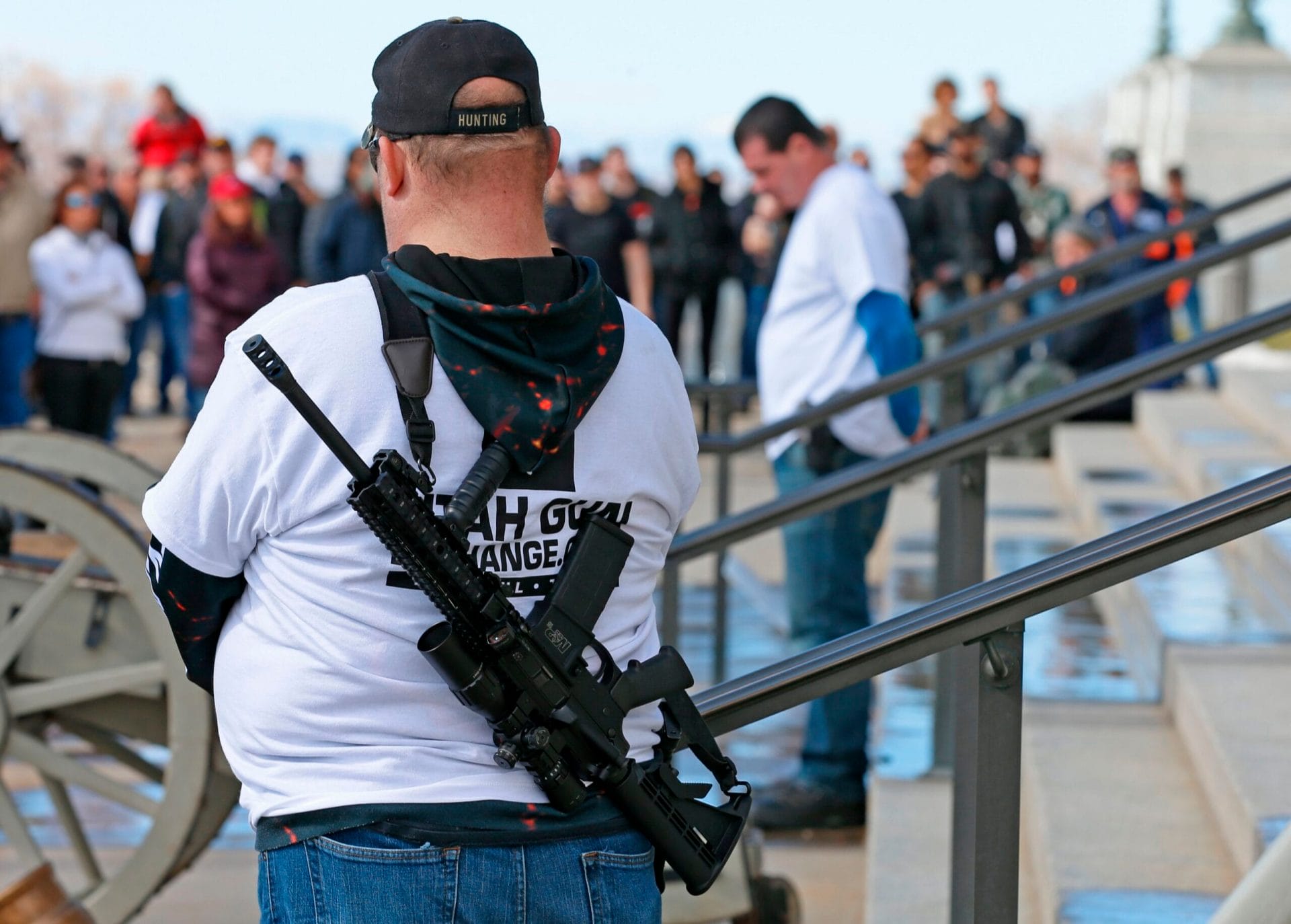
Public health constraints due to the COVID-19 pandemic and other factors in 2020 triggered a surge of armed demonstrations at government buildings and civic spaces nationwide. Reporting indicates more than 560 documented incidents of armed demonstrations between January 2020 and June 2021 alone.
In one widely documented case, demonstrators entered the Michigan State Capitol carrying rifles and tactical gear while emergency public health measures were under debate. Later that same year, armed far-right groups and militia members breached the Oregon Capitol. Even absent protests, firearms have created safety risks inside legislative buildings. While debating an expansion of sensitive place protections in 2024, lawmakers in Colorado cited multiple firearm safety lapses involving their own colleagues.
In the wake of these incidents, many states moved to strengthen protections for democratic institutions by prohibiting guns in government buildings and other sensitive democratic spaces. Around the same time, the Supreme Court case New York State Rifle & Pistol Association v. Bruen reaffirmed that governments may restrict firearms in “sensitive places,” explicitly recognizing legislative assemblies and government buildings as locations where firearm restrictions have historically been constitutionally permissible.
Today, 23 states currently prohibit firearms to some degree within state capitols, statehouses, or state offices. Twenty-five states and Washington DC explicitly prohibit some or all types of firearm carry at polling locations, drop boxes, or counting facilities. In 2025, Colorado joined California in passing the PEACE Act, a comprehensive bill drafted by GIFFORDS and the Brennan Center for Justice which aims to stop the armed intimidation of voters.
Today, however, Republican lawmakers are advancing legislation to expand where firearms may be carried inside state capitols and other government buildings. While most proposals have thankfully stalled, their introduction signals a coordinated effort to weaken sensitive-place protections and normalize guns in spaces historically treated as secure civic institutions.
Republican lawmakers in multiple states are framing these efforts as a matter of self-defense or consistency with broader right-to-carry laws. So far, only a small number of measures have succeeded, but proposals continue to surface across the country.
In 2025, Wyoming (HB 0172) became one of the first states to enact this type of legislation, allowing concealed carry in publicly accessible areas of the state capitol, including legislative meetings and committee hearings.
Several bills introduced this year reflect the same pattern:
- Oklahoma (HB 3094) would have permitted licensed handgun carry inside the capitol. The measure failed amid concerns raised by capitol security officials, including the Oklahoma Department of Public Safety Commissioner.
- Iowa (SB 2153) would authorize members of the general assembly to obtain professional weapons permits allowing them to carry firearms anywhere in the state, including government spaces. The bill advanced out of subcommittee but has since stalled.
- Ohio (HB 460) would allow legislators, judges, and certain statewide officials to carry concealed firearms inside government facilities. The bill has been referred to committee.
- West Virginia (HB 4370) proposed allowing concealed firearms on capitol grounds, but failed upon adjournment.
Even when unsuccessful, these efforts slowly erode critical safeguards and normalize the presence of firearms in civic spaces.
By contrast, Democratic-led and more politically moderate legislatures have largely maintained their focus on reinforcing institutional security. As early as 2021, Virginia enacted SB 1381 prohibiting weapons in Capitol Square and state buildings. In 2024, lawmakers in Colorado (SB 24-131) passed an expansive sensitive places law that explicitly prohibited firearms in legislative chambers and hearing rooms.
Recent efforts have continued this approach. In 2026 Minnesota (HB 3357) and Vermont (HB 368) also advanced legislation to broadly prohibit weapons in their state capitols.
Debates over firearms in state capitols extend beyond mere legalities; they strike at the heart of democratic integrity. Legislative spaces are where elected officials deliberate, journalists report, and citizens engage.
Allowing armed citizens in these environments introduces serious risks:
- Intimidation: The mere presence of firearms is known to deter participation and chill open debate.
- Accidents: Even trained individuals make mistakes, and crowded public settings increase the risk of unintentional harm.
- Security breakdowns: Additional firearms complicate existing law enforcement threat response and undermine coordinated safety efforts.
Rolling back restrictions on firearms in government buildings does not just weaken policy—it changes how people experience democracy. When individuals feel unsafe entering a capitol, attending a hearing, or voicing their views, participation narrows and public trust erodes.
Protecting these spaces is not abstract; it is about ensuring that people can engage in civic life without fear. Keeping guns out of the places where democracy functions is essential to preserving both public safety, accessibility, and the integrity of our democratic institutions.
GET THE FACTS
Gun violence is a complex problem, and while there’s no one-size-fits-all solution, we must act. Our reports bring you the latest cutting-edge research and analysis about strategies to end our country’s gun violence crisis at every level.
Learn More