How 20 Years of Gun Industry Immunity Has Made Gun Crime Worse
These days, you are 35% more likely to be a victim of gun homicide than before PLCAA became law.
Most people have never heard of the Protection of Lawful Commerce in Arms Act (PLCAA)—but this little-known law has fueled corporate recklessness and allowed gun violence to fester for two decades. It passed 20 years ago this week, and pretty much everything has gotten worse since then.
The Protection of Lawful Commerce in Arms Act is a 2005 federal law that gives the gun industry unique immunity from most civil liability.
In every other industry, business leaders know they must behave responsibly because if they don’t, their reputation suffers, they can lose customers, and a court may find them liable if it’s proven they caused harm. This model provides motivation for profit-driven enterprises to conduct themselves responsibly—it’s both good for profits and the greater good. Those responsible businesses can also have confidence that the justice system will dismiss unwarranted cases, which happens every single day.
Gun industry executives, on the other hand, were tired of acting responsibly. They wanted to sell guns and make money while forcing others to suffer the consequences.
In 2005, greedy gun industry CEOs convinced Congress to give them a free pass to shield them from lawsuits. They saw what happened to the tobacco industry in the courts after decades of irresponsible business practices that resulted in countless preventable deaths and they thought “uh oh, that sounds an awful lot like what I do here every day.”
Gun industry immunity was the biggest special interest giveaway in the history of the United States.
The overall gun industry is composed of hardworking men and women who do honest work to provide for their families. Most employees bear no culpability for the industry’s turn—that blame lies on those setting strategy from the top.
Since PLCAA became law, everything has gotten worse… except for gun industry profits. Gun murders and suicides have skyrocketed while gun industry executives continue to get rich off the pain they inflict in our communities. They’ve hired more lobbyists than ever and donated more money to more politicians than ever before—all while the body count has continued to climb.
The gun industry will deny it, but those are the facts.
Gun murders? Up.
After PLCAA was signed into law, the number of annual killings by way of guns increased from 12,352 in 2005 to a peak of nearly 21,000 in 2021. The most recent final CDC data shows that there were 17,927 gun homicides in 2023. And it’s not just raw numbers—the per capita gun homicide rate also grew at an alarming pace over the same period of time. These days, you and your family members are 35% more likely to be a victim of gun homicide than when PLCAA passed in 2005.
Gun deaths? Up.
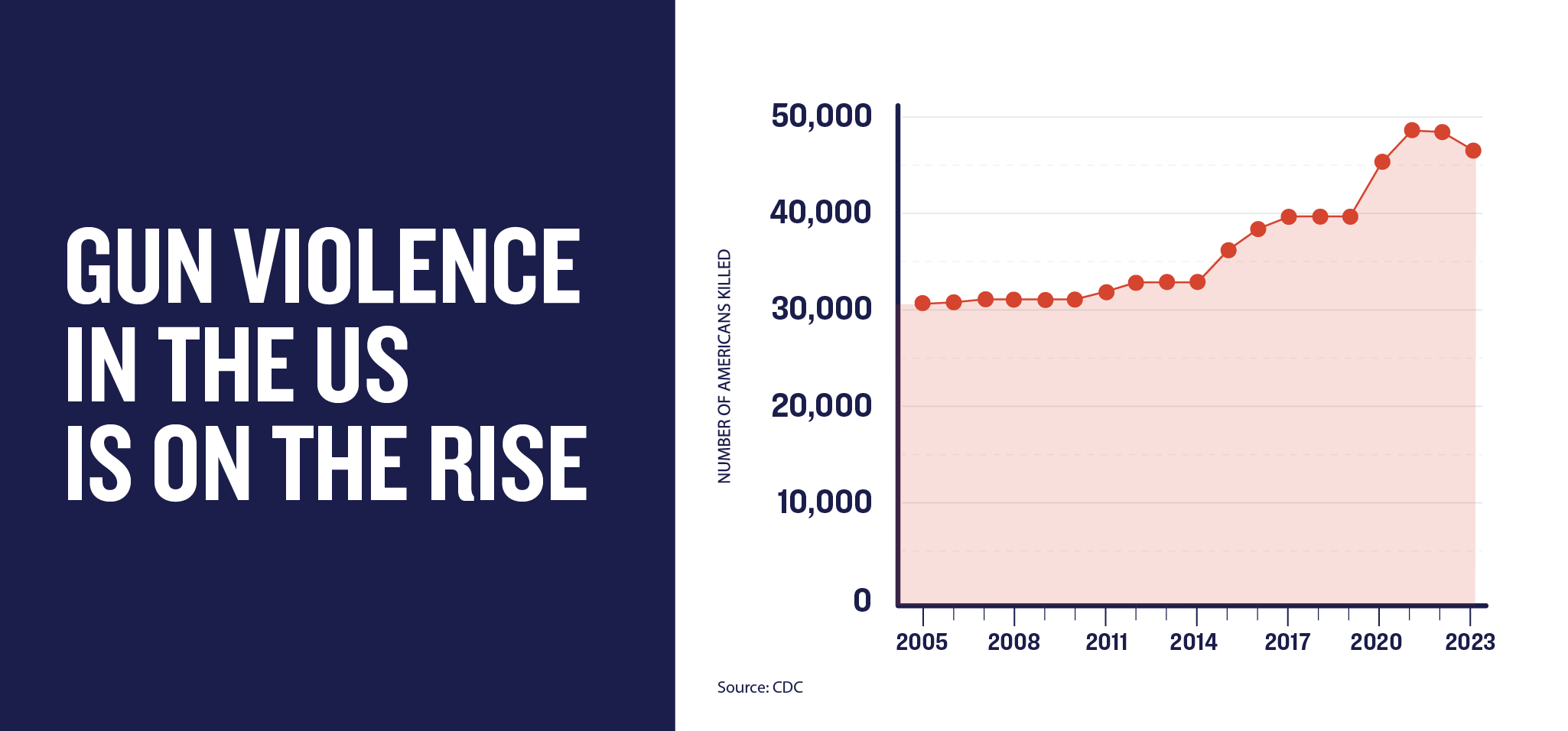
The rise in total gun deaths is equally alarming and should trouble anyone who cares about their fellow Americans. In 2005, 30,694 people were killed by guns. But in 2023? It was a staggering 46,728. That’s a 52% increase in gun deaths during a period of time where the US population increased by a mere 13%.
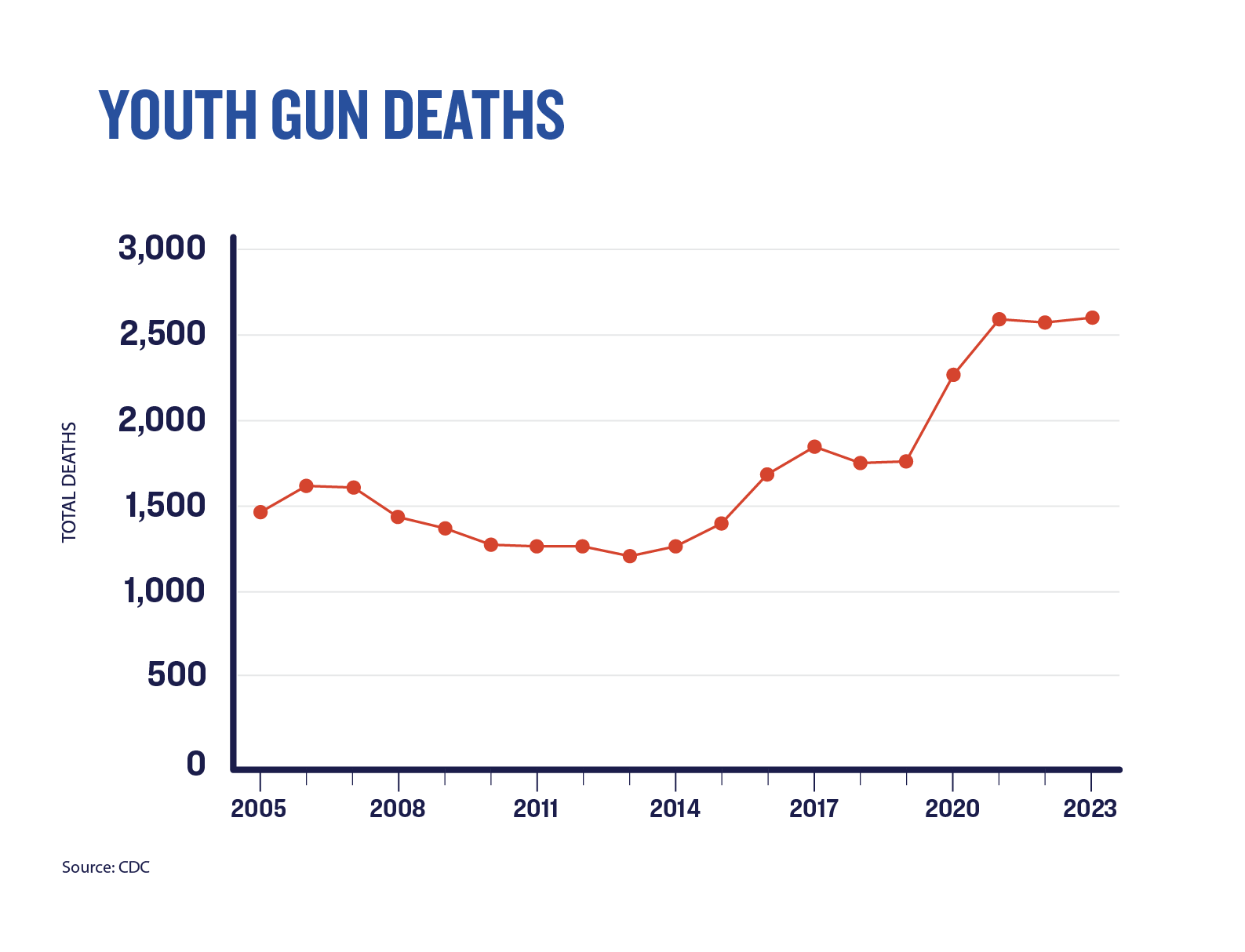
Gun suicides have increased even more dramatically over that same period. In 2023, there were 27,300 gun suicide deaths, a 61% increase from when PLCAA passed in 2005. Likewise, gun deaths among young people have gone up by a staggering 73% in just 20 years—increasing from under 1,500 in 2005 to over 2,580 in 2023.
Gun industry profits? Through the roof.
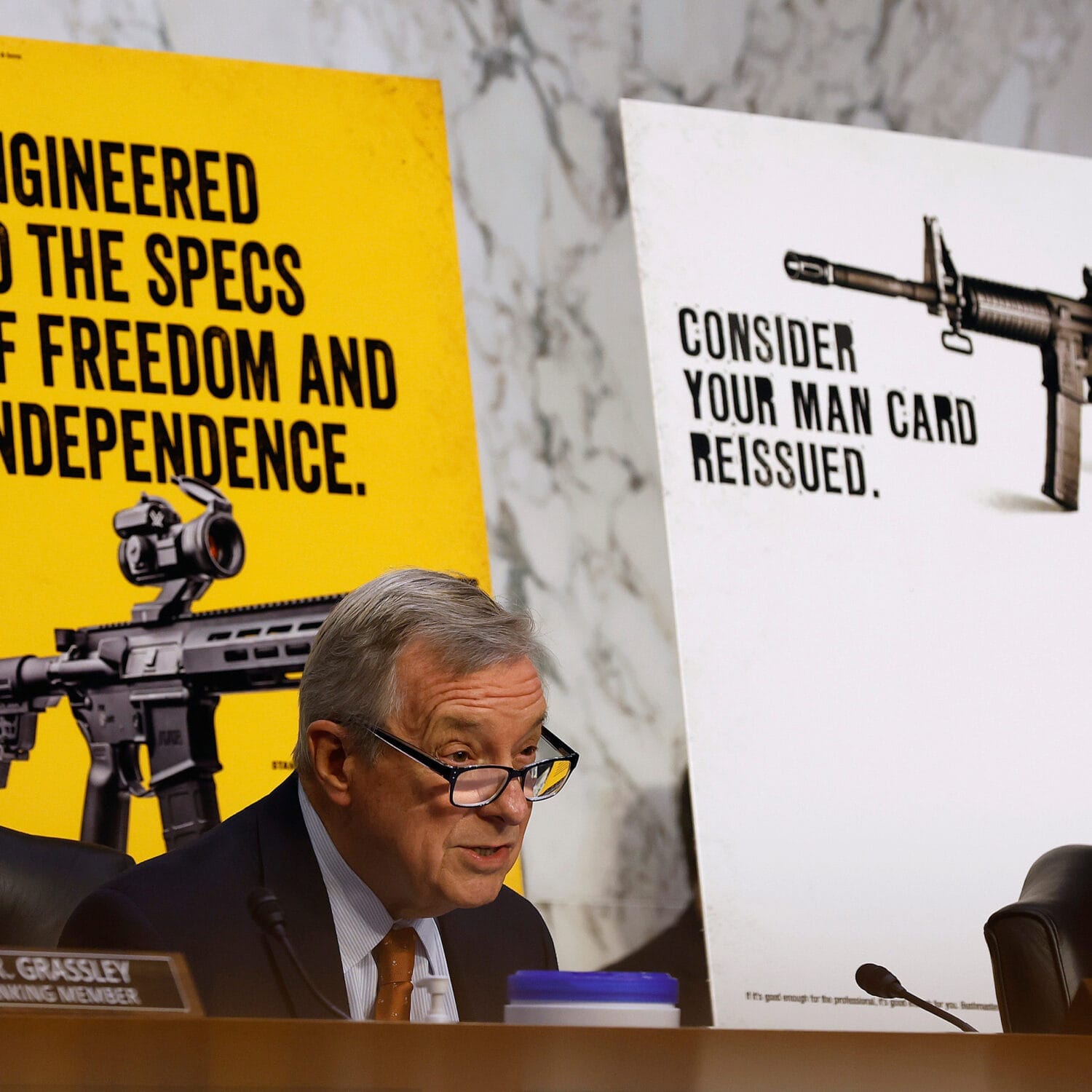
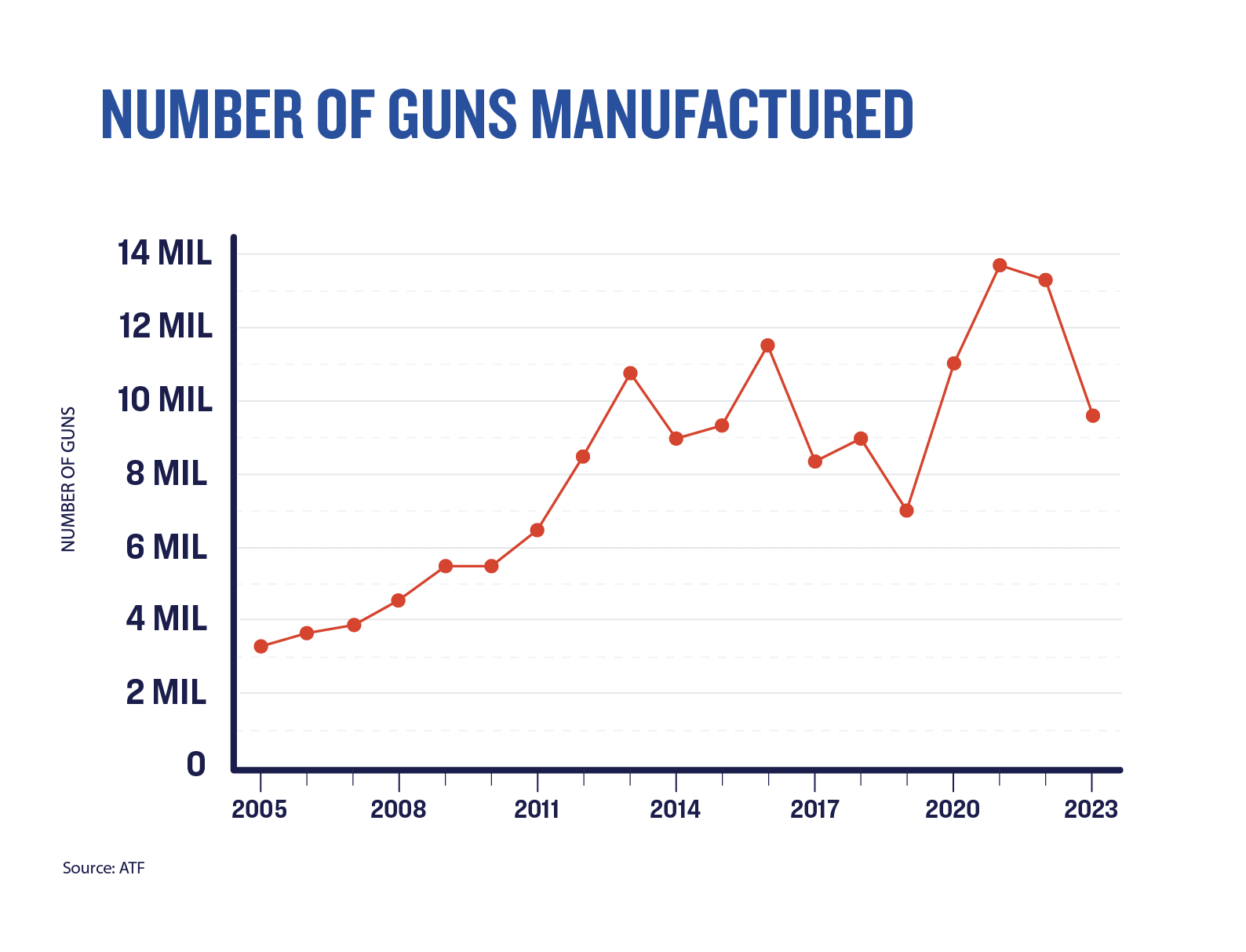
As gun deaths rose, the industry found new riches in encouraging repeat purchases—adopting marketing practices that pushed customers to assemble an arsenal. According to the ATF, the number of guns manufactured in America after PLCAA increased 325%, from 3,241,494 in 2005 to 13,806,940 in 2021.
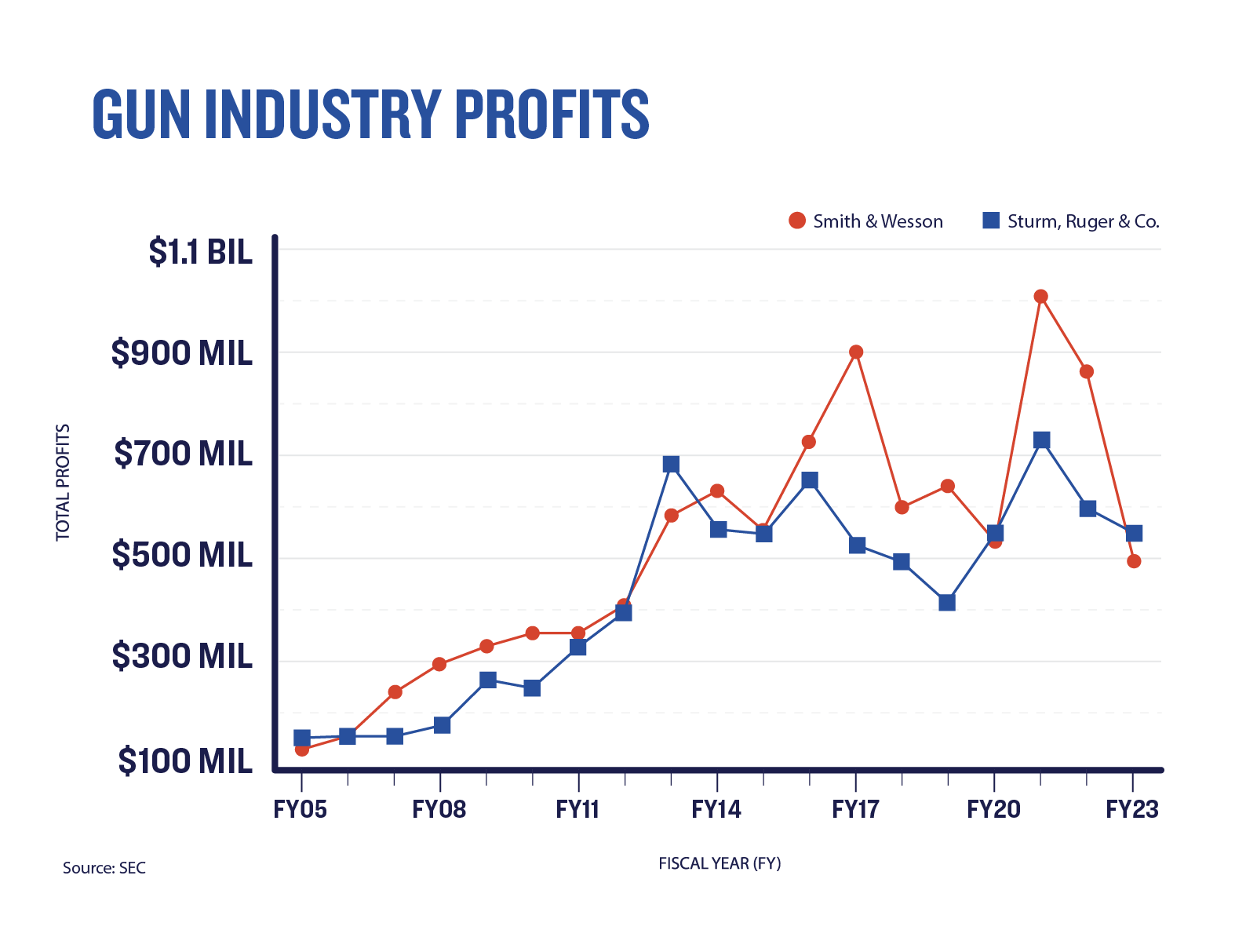
Most American firearms companies are privately held, meaning their financial data isn’t public. But the two biggest exceptions provide a startling window into just how much industry revenue has increased since PLCAA was enacted in 2005.
Smith & Wesson, the largest manufacturer of handguns in the US, took in $125.8 million in 2005. By 2024 that number had ballooned to $535.8 million, a 325% increase. Sturm, Ruger & Co., another publicly traded firearms company and the largest firearm manufacturer in the US, experienced similar growth. Ruger reported net sales of $154.7 million in 2005 and $535.6 million in revenue in 2024—down from a peak of $730.7 million in 2021.
Gun industry political spending? Way up.
Gun industry CEOs and sellout Republican lawmakers are a match made in heaven. Industry executives know that extreme Republican politicians only care about one thing: their own careers. They know that for the right price, many Republicans will be more than happy to back dangerous legislation that will increase gun crime and put their own constituents’ lives at risk. In return, the gun industry and advocacy groups reward them with campaign cash, direct mail, and TV ads.
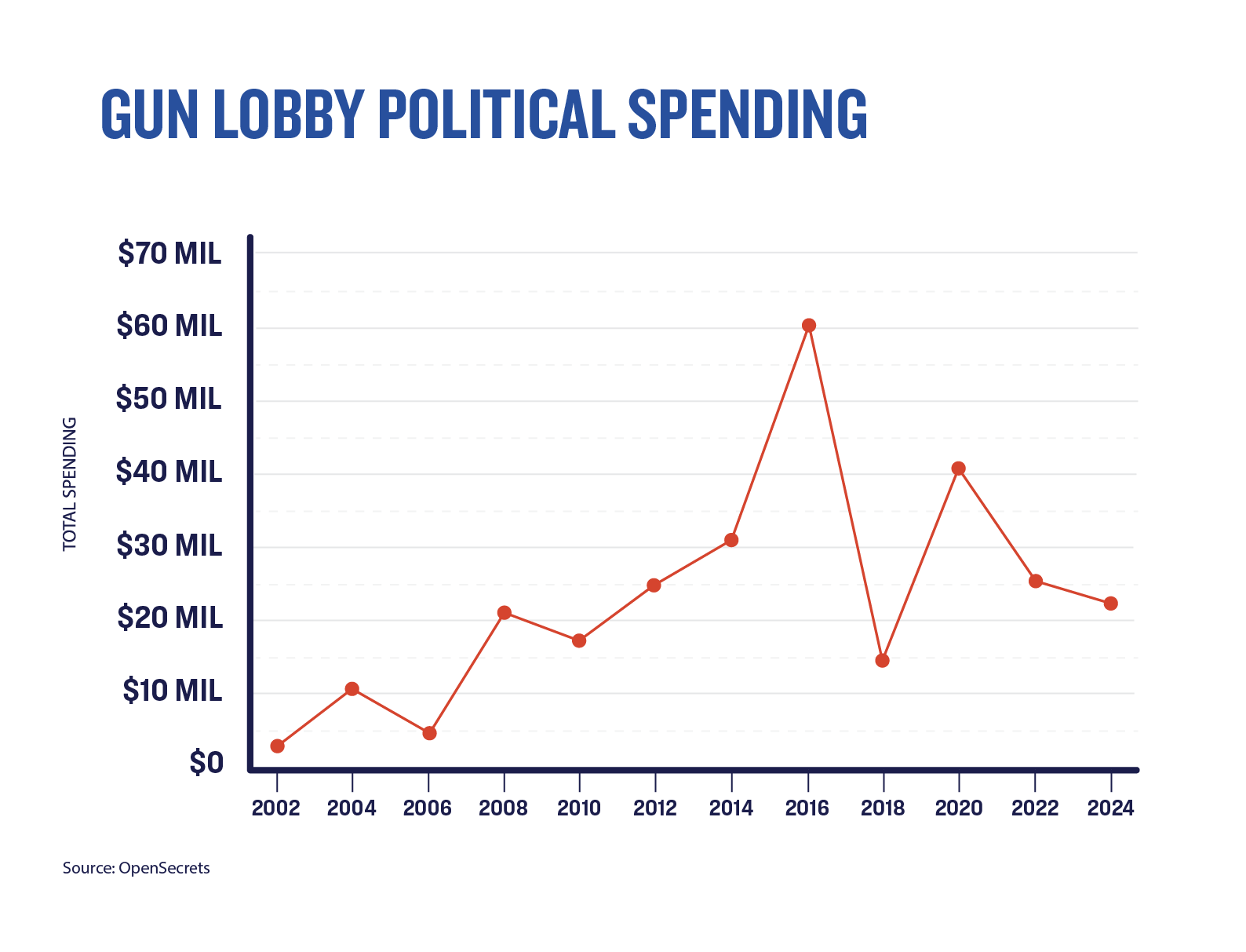
Since the 109th Congress passed PLCAA and President George W. Bush signed it into law, anti-safety gun groups have ramped up political spending to scratch the backs of those who do their bidding in office. In the 2004 election cycle, they spent just shy of $11 million on electoral politics. In the post-PLCAA days of 2016 and 2020, their spending exploded to $60.5 million and $40 million, respectively.
Since President Trump took the oath for the second time, Americans have had a front row seat to what that blood money buys. Learn about the litany of dangerous things the Trump administration has done to reward his gun industry CEO campaign donors.
Gun industry lobbying? Way up.
When a dangerous person can’t get their hands on a gun, no one sees a dime. For executives in the gun industry, that’s a serious problem that must be dealt with. How? It’s simple—just convince their elected lapdogs to pass laws that make it easier for criminals to get their hands on weapons. After all, the gun industry just bought their elections for them; it’s the least they could do in return.
As a result, the industry makes money on the front end AND when they exploit the threat of increased violent crime to sell even more guns in the name of self protection. In the twisted mind of executives, that’s win-win.
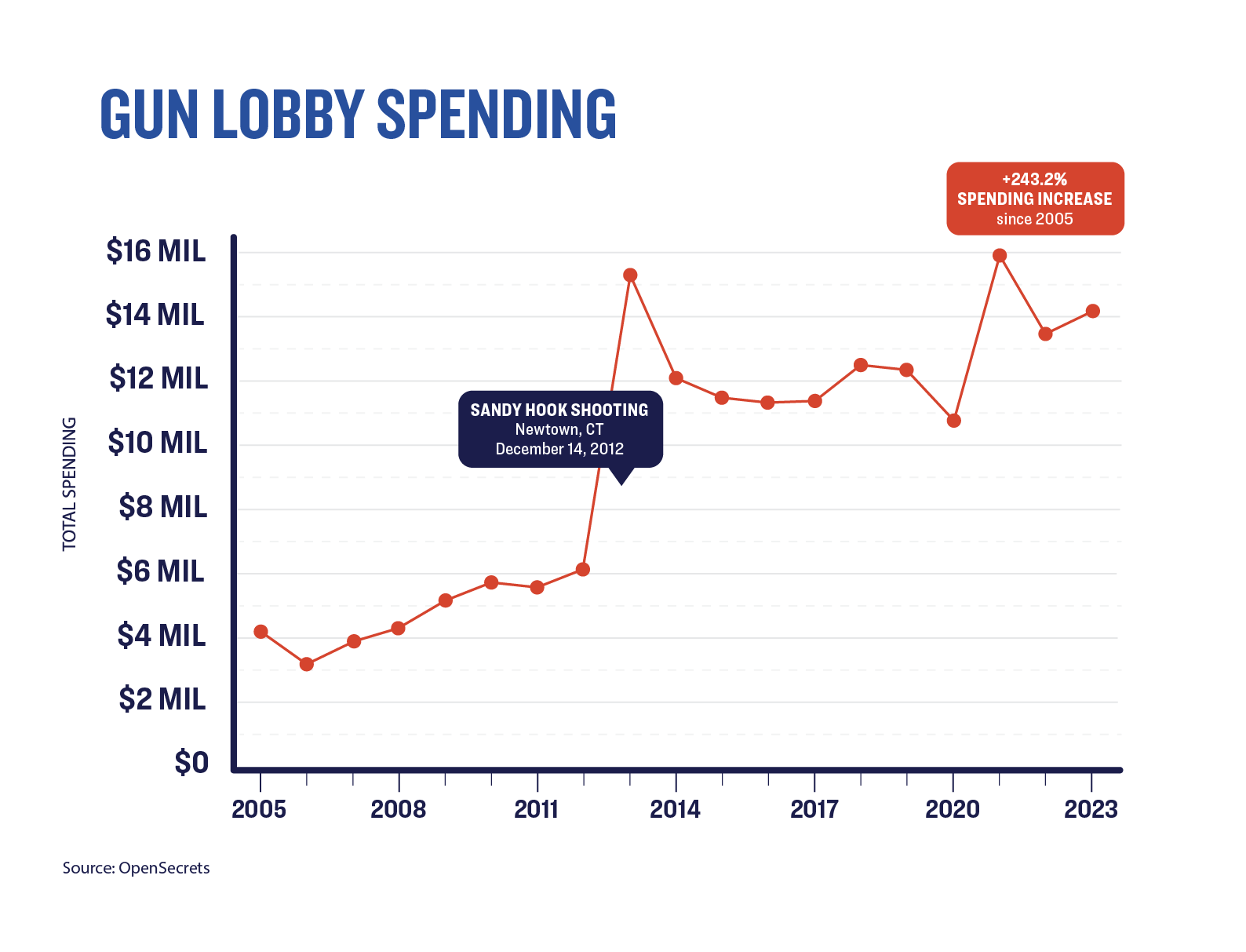
In 2005, the year PLCAA became law, gun industry affiliated companies and organizations spent $4,078,607 on lobbyists. That number has skyrocketed to $14,753,870 in 2024, and has twice reached more than $15 million (in 2013 and 2015).
If the lobbyists get their way, gun crime will get worse—just look at what’s happened so far this year. Doing the gun lobby’s bidding, Republicans snuck a provision into Trump’s Medicaid-gutting budget that would repeal mandatory background checks on gun silencers and sawed-off shotguns. Had they not been stopped by Senate procedural rules, gun silencers would be sold without background checks for the first time in nearly a century, subjecting them to the same loopholes and trafficking that fuel today’s epidemic of gun violence. (The gun lobby is currently trying to accomplish in court what it couldn’t in Congress.) And soon, Republicans and their lobbyists are likely to try and pass legislation that would let virtually anyone to ignore local laws and carry concealed firearms across state lines.
Twenty years of immunity have shown us exactly what happens when an industry is shielded from responsibility: more deaths, more fear, and more money for those who cause them.
The people who get rich off of gun crime in this country want nothing more than for our side to pack it in and go home. They want us to feel hopeless and to shut down any conversation about reforming gun laws to reduce crime. Luckily, we stopped falling for that. There are things we can do—and are doing—to help victims and survivors of gun violence get the day in court they deserve.
As you’ve seen, PLCAA is a legitimate obstacle to holding bad actors accountable. But its foundations have begun to crack.
Through State Legislation
While the gun industry likes to claim that PLCAA bars any plaintiff from bringing any case in court, that’s far from the reality. The law includes language permitting litigation when “a manufacturer or seller of a qualified product knowingly violated a State or Federal statute applicable to the sale or marketing of the product.” In other words, lawsuits are allowed—but only if states have enacted laws creating a standard of conduct for the marketing and sale of firearms, and if these standards are knowingly violated by industry members.
Beginning in 2021, GIFFORDS and allies in the gun violence prevention space have worked diligently alongside state lawmakers to put laws in place that empower victims and survivors to bring suits against bad actors in the industry. Currently, 10 states have strong gun industry accountability laws.
Through Litigation
GIFFORDS attorneys are committed to holding the forces that drive gun violence accountable for their role in this uniquely American epidemic. We’ve joined forces with government officials and gun violence survivors to sue ghost gun manufacturers, social media corporations, and even the NRA for jeopardizing public safety—and we’re just getting started.
By Fighting for PLCAA Repeal
GIFFORDS and our partners work everyday to educate voters and lawmakers about the horrors reckless gun industry conduct inflicts on innocent people. It won’t be quick or easy, but we are building a movement that will finally hold bad actors in the industry accountable for the harm they cause in our communities.
MEDIA REQUESTS
Our experts can speak to the full spectrum of gun violence prevention issues. Have a question? Email us at media@giffords.org.
Contact