
An Interview with Gun Violence Prevention Advocate Ashley Monterrosa
“Gun violence prevention isn’t just about stopping someone from obtaining or using a gun. It has to also be about creating conditions where violence is less likely to happen in the first place.”
Ashley Monterrosa has spent the years since her brother’s death investing in young people. As the co-founder of the Sean Monterrosa Project, a board member of the California Endowment and Youth Over Guns, and a member of GIFFORDS’s Latino Advisory Council, her wide-ranging efforts have spanned advocacy, youth and Latino engagement, philanthropy, organizing, and more.
We spoke with Ashley during Hispanic Heritage Month about turning grief into action, police shootings and the cycles of violence they bring, and what her work looks like these days.
This interview is edited for length and clarity.
GIFFORDS: Could you walk us through your journey with gun violence and gun violence prevention, and how you initially got involved?
Ashley Monterrosa: I lost my brother in Vallejo, California, on June 2, 2020. His name is Sean Monterrosa, and he was shot by a member of the Vallejo Police Department, specifically Officer Jarrett Tonn. It was in the middle of a George Floyd protest. It was the day before my 20th birthday, which was on June 3.

That’s really what catapulted me into this space. Shortly after, my sister and I founded the Sean Monterossa Project. In early 2020, it was just mutual aid, rapid response on the ground, and civil disobedience. We were marching, gathering signatures, trying to figure out what justice looked like.
Eventually, people began investing in my sister and me, and we decided that we really wanted to use this project to invest in young people coming out of the system. Whether it’s through scholarships for higher education, workforce development for young people—we want to create opportunities to do civic engagement and expose young people to the outdoors.
We’re finding ways to help educate them outside traditional institutions, whether we’re camping, we’re hiking, or we’re river rafting. Just taking Black and Brown young people out of their urban city element. A lot of the young people that we serve live in San Francisco, but don’t even go to the other side of the city where there’s a beach.
So my entry into gun violence is through police violence. And one thing I’ve become very clear about through this work is that we can’t compartmentalize gun violence. Police violence is gun violence. The person holding the firearm might be different. And the systems surrounding that violence may be different. But families are still left grieving, and communities are still very much traumatized. Life is still gone.
So when we talk about gun violence, I believe that we have to be willing to look at the full ecosystem of violence in this country.
Can you talk some more about your relationship with your sister, Michelle, and the work that you do together?

So, my sister’s the oldest, I’m the youngest, and Sean was in the middle.
And after my brother was killed, Michelle and I got really close. Losing your sibling brings you close. And we’ve been able to do amazing work together. Whether it’s through the youth development work that we’re doing at the project or something else, I think it’s a blessing to have a sister to do this work with. I can’t imagine doing all of this by myself.
My sister is currently finishing her master’s degree in ethnic studies, and she’s exploring PhD programs. It’s about to be seven years since we lost our brother. But there’s been so much beauty that has come out of such a tragic experience for the both of us. And I think it’s a blessing to have a sister in the movement.
You also sit on the board of a number of some great organizations doing meaningful work. How does your role as a board member help you advocate for community safety?
It’s an honor and privilege to sit on the board of the California Endowment. It’s the largest private health foundation in California, with an endowment of $4 billion. I’m one of the youngest people on the board ever, in history. And I help identify who we can invest in, in terms of philanthropy. Organizations that are a little bit newer or might have not had the opportunity to be funded like this, but are doing violence prevention or gun safety work.

I don’t take this responsibility lightly. Every time I’m in the room, I’m thinking of the lives that we’ve lost, of our young people, of our elders, of everyone who has lost their life at the hands of gun violence.
Most of the time, the folks on these boards know the subject, but they aren’t really talking about the actual violence that’s happening in our communities. So I feel an immense amount of gratitude to be in the room, but also to help challenge people to think about what is happening in our community.
I’m also on the board of the Youth Over Guns. I’m always thinking about how we can bring in different perspectives to the conversation around gun violence. I’m in a really unique position, where I’m able to challenge and get folks to at least hear me out but also to shift dollars into community folks who are doing violence prevention work.
How did you get involved with the GIFFORDS Latino Advisory Council, and what do you hope to achieve with it?
I went to DC a few years ago to speak at the National Academies for Sciences, Engineering, and Medicine about community safety as a social determinant of health. My sister was also doing a speaking engagement at the Center for American Progress. Vanessa Gonzalez (former GIFFORDS Vice President of Government and Political Affairs) happened to be on her panel, and we connected through that.

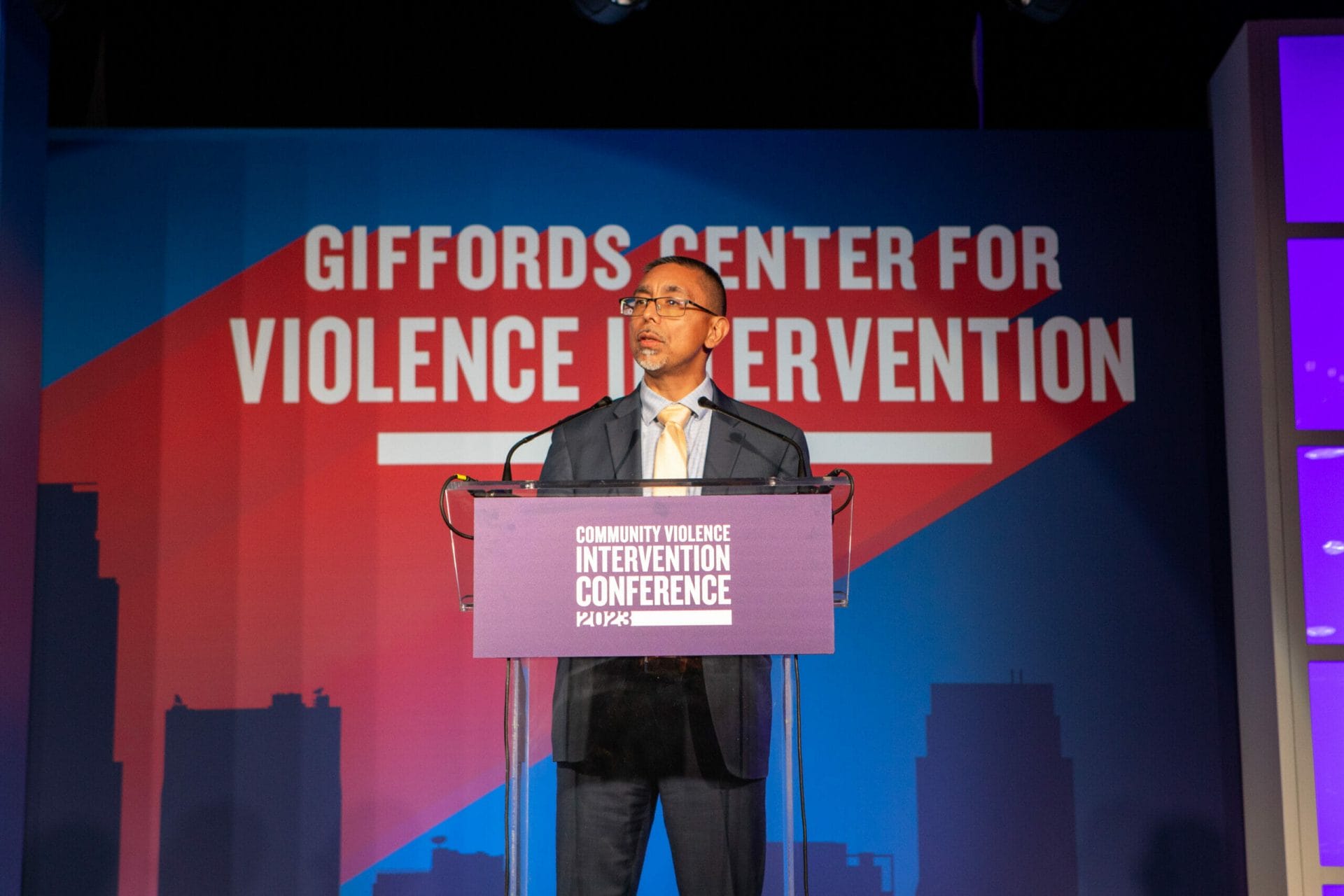
When Vanessa and GIFFORDS started working on this idea, they reached out to me to join. And it’s been a great year and a half! In July, we were at the GIFFORDS Community Violence Intervention Conference, and that was amazing. A large chunk of the council members were together in one place, and it was really nice to just talk strategy and get to know each other.
I also helped host a cafecito in San Francisco as part of the council. Emma Brown, GIFFORDS’s executive director, joined us, and we held a community conversation with folks doing the work but who don’t ultimately see themselves as part of the gun violence prevention space. I know the organizations and folks who were in the room at least felt seen. A lot of times, people think national organizations are so distant from the work that’s happening on the ground. So it was great to connect those two pieces.
As for what I hope to achieve… I think it would be really cool to go around the country and have more conversations on the ground about gun violence and Latinos, with the communities we’re trying to serve. Maybe we do more cafecitos, or we expand to something like a community forum, where it’s more open. I’d like to hear more about what a specific community needs, or what some of their community experiences are in relation to gun violence.
What I really appreciate about the council is having an opportunity to bring my lived experience into a national gun violence prevention conversation. I come into this movement as Sean’s sister, as a community organizer, as a board member, and as someone who ultimately believes we have to think expansively about what violence prevention means.
I think we can advocate for stronger gun laws, while also asking why so many communities experience so many different forms of violence. We can talk about community violence while talking about police violence, and we can talk about mass shootings while talking about suicide and domestic violence. And these issues aren’t identical, but we don’t have to put them in separate boxes to recognize that they’re connected. And I want to make sure that’s the perspective that I’m bringing into the Latino Advisory Council.
How do you think your background and identity as a Latina has influenced your approach to this kind of organizing work, with violence prevention and youth?
When we talk about policy and gun violence, I think we sometimes miss who we’re trying to advocate and create all these things for. And I think the opportunity, at least for me, in doing the work and having these identities and experiences is really just simplifying things, explaining and messaging things to our community in a way that they’re really going to understand.
In philanthropy, we use so many big words, like “strategic refinement” and whatnot, and by doing so we miss the community that we’re trying to serve. We need to change the language and make it accessible to the people that we’re trying to serve, and I think that’s something that I do really well. Being able to work at the intersections of different communities and identities gives me a great opportunity to help build up young people.
A lot of people in this community still don’t think that gun violence is really a Latino issue. They think that what we see in the headlines, issues like immigration, are our only issues. But that’s not true. And I think now we’re seeing so much of ICE that we can connect with the Latino community to really think about what’s happening. What’s happening with ICE is gun violence, and we can create more space and conversations to hold all of that.
Can you talk about some of the big achievements—either generally, or to you specifically—that you’ve seen in the fight to end gun violence since you started this work?
In California, we have Senate Bill 2, the Kenneth Ross Jr. Police Decertification Act of 2021. At the time, California was one of just a few states that didn’t have a process to decertify law enforcement officers, like you would for a surgeon or attorney who was losing their license due to malpractice.
I don’t want to take any credit for the bill—it’s named after Kenneth Ross Jr., who was killed by an officer in Los Angeles. His family and some allies in the California legislature organized and wrote this bill, which created a statewide process to investigate and decertify officers for serious misconduct.

But this was a really big win for me, because when Officer Jarrett Tonn killed my brother, this process didn’t exist. Officer Tonn had a record of firing his gun at a person while on duty and using excessive force. If someone is a bad actor, we need some type of consequence and accountability. And now there’s a new pathway: Victims, survivors, and families can file to have officers decertified.
I think a smaller win, but still important to me, is that the city of San Francisco recognized Sean. There is now a Sean Monterrosa Boulevard in the city. It’s the street we grew up on, right at the corner of the elementary school that we all attended.
These little wins give us the energy to continue pushing and persevering. We don’t do the work for the accolades. But I think my sister and I, and our family specifically, are very adamant about creating physical beacons where we’re able to honor Sean. There’s a big mural of Sean at the start of the Latino Cultural Arts District in the Mission, which says “Injusticia a uno es Injusticia a Todos,” meaning “Injustice for one is an injustice for all.” And I think it’s a beautiful reminder of Sean, who was a San Francisco native and the son of immigrant parents. A lot of people can see themselves in Sean. You may think police violence is such a distant thing, but it can happen to you. It can happen to anyone.

You spend a lot of your time and energy working with young people. How do you build trust with them, and how do you ensure there is sustained participation?
I feel like folks in this sector, we love to flex our titles. But young people don’t care about your title. Young people want to meet you for who you are.
Starting on a personal note is crucial. At the bare minimum, ask them what they like to do for fun, or share what you do in your spare time. Find something to connect with them about. Sports, an activity, a certain experience. Talk about the 49ers, or the terrible season the Giants just had. Talk about cars and the lowrider culture here in San Francisco. That’s really what it is.
Also, it’s important to create an opportunity where young people feel seen and have space. Working with young people, a lot of them are first generation, or are coming out of the system. They don’t have a third space. That’s what the Sean Monterrosa Project tries to do, to find and make that third space accessible.
Is there an issue or a win that you think isn’t getting as much attention as it deserves?

Definitely police violence. We can’t just decide that one shooting belongs in the gun violence conversation while another doesn’t, just because the person who pulled the trigger had a badge on. And for families like mine, those distinctions don’t change the reality that someone is now dead.
My brother was shot by an AR-15–style assault rifle. There was the officer who was driving, and one in the passenger seat. The shooter was in the pickup truck sitting in the back seat, and picked up his gun and shot through a windshield. It was basically a police drive-by, but it was deemed okay because it was law enforcement.
When we’re talking about Black and Brown communities in particular, these forms of violence can overlap. A young person can experience community violence, and lose someone to police violence, and have a family member impacted by incarceration, and still be expected to move through school and life carrying all of that trauma.
And I think if our prevention strategies only address one piece of that experience, then we’re missing the larger picture.
Gun violence prevention isn’t just about stopping someone from obtaining or using a gun. It has to also be about creating conditions where violence is less likely to happen in the first place. That means housing, mental health care, education, economic opportunity, community violence intervention, healing, and trusted crisis response.
It’s all connected. It’s about building the conditions that allow people to be safe and experience joy.
What helps you stay hopeful and motivated about gun violence prevention?
I would say my faith and my family. And I think what grounds me a little bit more is focusing on the fact that it’s not on me to do all the work. If I need to take a step back, I know the work will be okay. Knowing there’s a huge network of people with different approaches working toward the same thing helps me.
Thank you, Ashley Monterrosa, for your dedication, passion, and strength in our collective fight to end gun violence.
STAY CONNECTED
Interventions are most effective when they are supported by strong community networks. Sign up for Giffords Center for Violence Intervention’s newsletter to learn more about what’s happening in the field, relevant legislation, and funding opportunities.
The Latest

GIFFORDS statement on mass shooting in Erie, Pennsylvania
Oct 10, 2026

GIFFORDS endorses Helena Foulkes for governor and Kim Ahern for attorney general in Rhode Island
Oct 09, 2026

GIFFORDS PAC announces new ad against Anna Paulina Luna in FL-13
Oct 07, 2026