State laws can require responsible business practices by the gun industry, overcoming legal barriers that otherwise make it difficult to sue industry members that engage in harmful behavior.
For most businesses in the United States, civil liability can be used as an important check on irresponsible and harmful industry behaviors. But the gun industry hasn’t been treated like most businesses since President Bush signed the federal Protection of Lawful Commerce in Arms Act (“PLCAA”) into law in 2005. This law gives the gun industry exceptional immunity from most civil liability, protecting the irresponsible gun companies that are responsible for most of the guns used in crimes.
However, PLCAA was never meant to be absolute. Congress specified six categories of lawsuits that would not be subject to PLCAA restrictions. The most significant of these allows lawsuits against an industry member that knowingly violates a law applicable to the marketing or sale of firearms. This means that states can enact laws creating a standard of conduct for the marketing and sale of firearms and allow lawsuits when that standard is violated. In recent years, many states have enacted this type of legislation, giving victims of gun violence and public officials acting on the people’s behalf avenues to seek justice and compensation for harms caused by wrongful gun industry conduct.
Background
Civil liability plays an important role in promoting community and consumer safety. Traditionally victims harmed by wrongful industry conduct, or public officials acting on the people’s behalf, can seek fair justice and accountability in the courts by filing lawsuits seeking monetary compensation or other court-ordered relief when industries have negligently or recklessly caused harm or failed to take reasonable steps to prevent foreseeable harm. This possibility of civil litigation incentivizes industries to take reasonable steps to prevent their products or business practices from causing foreseeable risks to human life and wellbeing.
In too many cases, however, this principle does not apply to the gun industry. This is because, following a series of lawsuits in the 1990s holding certain members of the gun industry accountable for reckless business practices, the industry successfully lobbied for the Protection of Lawful Commerce in Arms Act (PLCAA), which gives gun manufacturers and sellers broad immunity from civil lawsuits.
PLCAA has many harmful effects–it allows the gun industry to avoid the financial incentives to implement safe and responsible business practices, encourages “head in the sand” behavior that gets in the way of safety innovations, and gives the most irresponsible industry members an unfair business advantage over their more responsible competitors who do take precautions to protect human life and well-being.
It is not, however, absolute, and it explicitly allows for lawsuits against gun industry members who knowingly violate a state or federal law regulating the marketing or sale of firearms. Because of this, states remain able to enact and enforce laws establishing standards of responsible conduct for the gun industry, and hold those who violate the law accountable through civil lawsuits.
In recent years, many states have done just that–currently, 10 states have enacted legislation requiring the gun industry to implement basic, responsible business practices to prevent harms like trafficking, illegal sales, and gun theft. If a member of the gun industry violates the law and someone is harmed as a result, then victims and/or government officials can sue that industry member. These laws ensure that even in light of PLCAA, the gun industry faces financial incentives to behave responsibly, and victims of gun violence have access to justice for the harms they have suffered.
Summary of Federal Law
In 2005, Congress passed the Protection of Lawful Commerce in Arms Act (PLCAA),1 a federal law that provides broad immunity from many lawsuits to manufacturers,2 sellers, and importers3 of “qualified products,” meaning firearms, ammunition, or component parts of a firearm or ammunition.4 For these purposes, PLCAA provides general immunity from lawsuits to federally licensed manufacturers, federally licensed firearm dealers and importers, and entities engaged in the business of selling ammunition at the wholesale or retail level.5 (This immunity also extends to certain firearm and ammunition industry trade associations).6
Generally, PLCAA prohibits plaintiffs from bringing what the law calls “qualified civil liability actions” against these industry defendants. “Qualified civil liability actions” are civil or administrative proceedings for damages or other relief brought by any person, including a governmental entity, “resulting from the criminal or unlawful misuse” of firearms, ammunition, or firearm or ammunition component parts by the plaintiff or a third party.7
Importantly, PLCCA provides six exceptions to its general industry immunity, authorizing the following types of lawsuits to proceed even if an intervening act occurred involving the criminal or unlawful misuse of the firearm industry member’s product:8
- An action brought against someone convicted of “knowingly transfer[ing] a firearm, knowing that such firearm will be used to commit a crime of violence” by someone directly harmed by such unlawful conduct;9
- An action brought against a seller (or importer) for negligent entrustment10 or negligence per se;
- An action in which a manufacturer or seller of a qualified product knowingly violated a State or Federal statute applicable to the sale or marketing of the product, if the violation was a proximate cause of the harm for which relief is sought. (Note that “State” laws are defined for these purposes to also include the laws of any U.S. territory as well as the laws of local political subdivisions, such as cities and counties);11
- An action for breach of contract or warranty in connection with the purchase of the product;
- An action for death, physical injuries, or property damage resulting directly from a defect in design or manufacture of the product, when used as intended or in a reasonably foreseeable manner, except that where the discharge of the product was caused by a volitional act that constituted a criminal offense, then such act shall be considered the sole proximate cause of any resulting death, personal injuries or property damage; or
- An action commenced by the Attorney General to enforce the Gun Control Act or the National Firearms Act.
Constitutional Challenges to PLCAA
Plaintiffs around the country have brought several cases arguing that the federal PLCAA gun industry immunity law is unconstitutional. To date, most have been unsuccessful. (See footnotes for case citations and descriptions). 12 However, a Pennsylvania appeals court panel ruled in August 2022 that PLCAA was an unconstitutional violation of the Tenth Amendment, which states that “The powers not delegated to the United States by the Constitution, nor prohibited by it to the States, are reserved to the States respectively, or to the people.”13
Summary of State Law
Firearm Industry Responsibility Laws
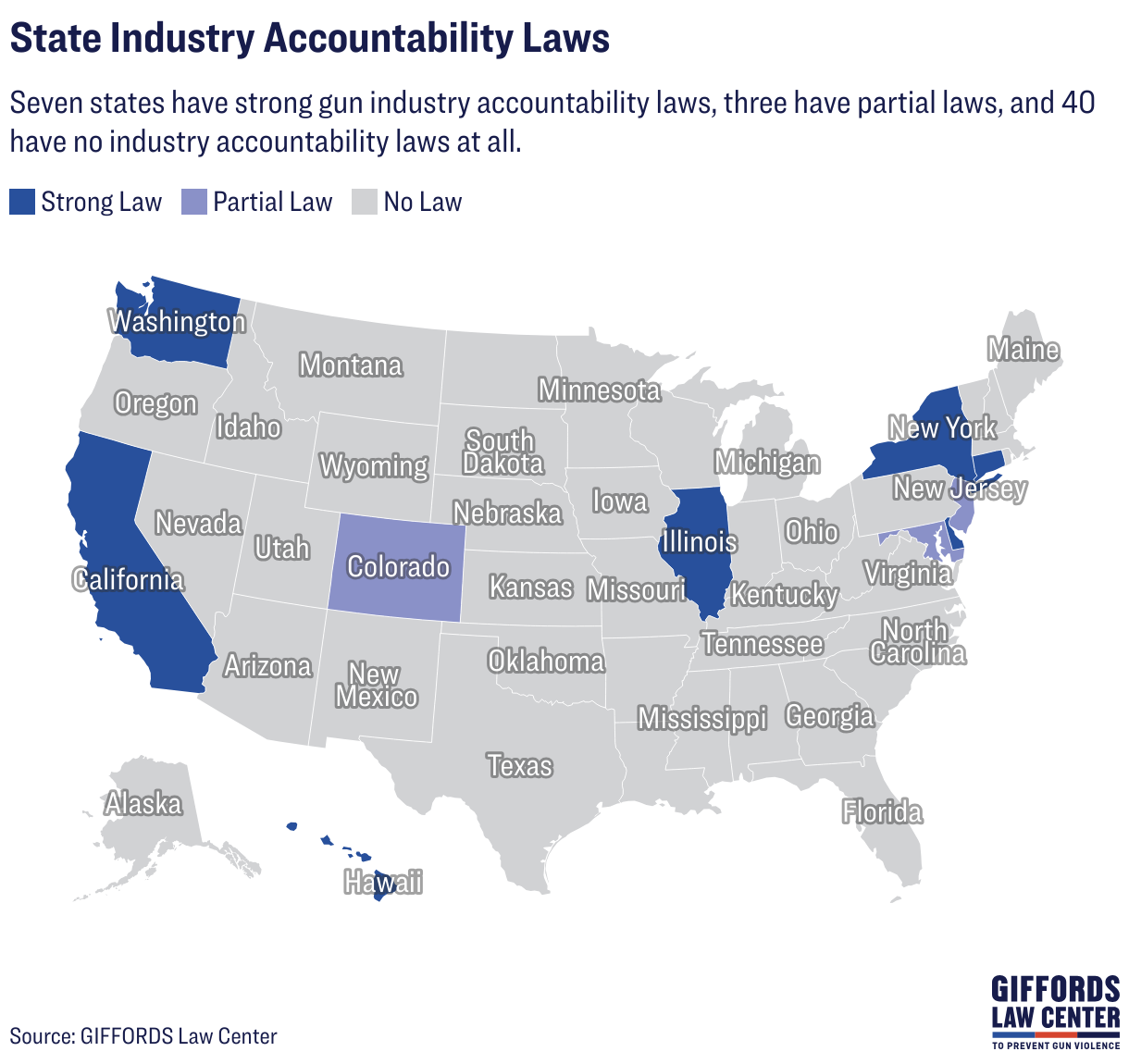
In recent years, several states have enacted legislation to establish a standard of conduct for the marketing and sale of firearms and ensure that victims and/or public officials have the ability to bring civil lawsuits against firearm industry actors who violate that standard. The state laws currently in place include:
- California (enacted July 12, 2022, and effective on July 1, 2023)14
- Colorado (enacted April 28, 2023, and effective on October 1, 2023)15
- Connecticut (enacted June 10, 2025 and effective on October 1, 2025)16
- Delaware (enacted and effective June 30, 2022)17
- Hawaii (enacted April 26, 2023, and effective on July 1, 2023)18
- Illinois (enacted August 14, 2023, and effective on August 14, 2023)19
- Maryland (enacted May 16, 2024 and effective June 1, 2024)20
- New Jersey (enacted and effective July 5, 2022)21
- New York (enacted and effective on July 6, 2021)22
- Washington (enacted April 25, 2023, and effective on July 23, 2023)23
As noted above, PLCAA includes a “predicate exception” allowing lawsuits against a firearm industry defendant who has knowingly violated a statute applicable to the sale or marketing of a firearm or other qualified product, if the violation was a proximate cause of the plaintiffs’ harm. By expressly codifying a firearm industry standard of conduct with obligations and prohibitions that are specifically applicable to the sale and marketing of firearms, these state laws fit squarely within PLCAA’s predicate exception, meaning the gun industry is not immune from lawsuits under the laws. There has been significant litigation in some cases over whether some generally applicable state statutes qualify as valid predicate statutes under PLCAA. But these states have acted to remove any ambiguity and expressly codify a firearm industry standard of conduct in the civil code with obligations and prohibitions that are unquestionably and specifically applicable to the sale and marketing of firearms.
The state laws are broadly similar and require firearm industry members to implement reasonable controls, such as standard procedures, safeguards, screening or security standards, and safe business practices, in order to prevent specified harms, such as requiring firearm dealers to take reasonable steps to prevent selling or distributing firearms to straw purchasers and gun traffickers.
Some laws, like the one passed in California, include some additional, broader requirements too, such as provisions (1) expressly requiring firearm industry members to take reasonable precautions to ensure they do not sell, distribute, or provide a firearm-related product to a downstream distributor or retailer of firearm-related products who fails to comply with the firearm industry standard of conduct,24 and (2) prohibiting firearm industry members from manufacturing, selling, or importing firearms and related products that are abnormally dangerous and likely to cause an unreasonable risk of harm to public health and safety.25
All states with these laws authorize the State Attorney General to file lawsuits to proactively enforce the firearm industry standard of conduct; some states like New York and California also empower certain other local officials to bring civil lawsuits to remedy violations that occur in their jurisdiction. Additionally, many states expressly create a new cause of action authorizing any person harmed by a firearm industry member’s violation of the law to file suit and seek compensation or other fair remedies in court.
In 2022, California also enacted a law expressly authorizing lawsuits against firearm industry defendants in certain cases. SB 1327 (enacted July 22, 2022 and effective on January 1, 2023) authorizes any person who is not an officer or employee of a state or local government in the state to file a civil action for court-ordered remedies and statutory damages of at least $10,000 per weapon involved in a legal violation, if plaintiffs establish that a defendant engaged in specified illegal conduct related to assault weapons, .50 caliber weapons, unserialized firearms, or the illegal sale or transfer of a firearm by a licensed dealer to a person under 21.
In 2023, California enacted AB 1089, which allows for lawsuits for conduct related to 3D printers and CNC milling machines. The Act authorized lawsuits against anyone who distributes any digital firearm manufacturing code to anyone else in California who is not a federally licensed firearms manufacturer, member of the Armed Forces, law enforcement agency, or forensic laboratory.26 AB 1089 also created a civil action against individuals who violate the criminal laws surrounding 3D printers and CNC milling machines (see Ghost Guns in California).27 For additional information, see Gun Industry Immunity in California.
Generally Applicable Laws
There has also been significant litigation over whether some generally applicable statutes fit under PLCAA’s predicate exception. For example, the Second and Ninth Circuit Courts of Appeals have both found in split decisions that PLCAA barred claims brought under generally applicable public nuisance statutes.28 The same result has been reached by state courts in Alaska and Illinois and a federal district court in Washington DC.29
State appellate courts in Connecticut, Indiana, and New York, however, have allowed such suits to proceed under generally applicable nuisance, consumer protection, unfair and deceptive business practice, or false advertising statutes.30
Perhaps most notably, in February 2022, after enduring years of litigation to establish their right to sue firearm manufacturers under Connecticut’s Unfair Trade Practices Act, the families of the children and educators murdered at Sandy Hook elementary school in 2012 reached a record $73 million settlement with the manufacturer that made and marketed the shooter’s assault weapon.
State Firearm Industry Immunity Laws
Unfortunately, if the same families had suffered an unspeakable tragedy like Sandy Hook in many other states, they may never have been able to seek justice at all–not due to PLCAA, but because of state-level laws giving additional immunity to the gun industry.
At present, 32 states provide broad immunity to the gun industry and/or prohibit cities or other local government entities from bringing lawsuits against at least some gun industry defendants. Two states in particular have enacted laws that tilt the scales of justice even further in favor of the corporate gun industry and against victims harmed by their products and practices. The laws in Arkansas and Indiana include punitive provisions that force victims who do attempt to file lawsuits against the gun industry to pay the defendants’ legal fees and costs in many cases. (These states don’t include any similar provisions requiring the gun industry to pay victims’ legal fees and costs for lawsuits that victims manage to bring successfully).
These extreme industry protection provisions lead to predictably cruel results: two parents who lost their daughter in a mass shooting in Aurora, Colorado, for instance, filed a legal action against companies that had sold the shooter thousands of rounds of ammunition, large-capacity magazines, and body armor over the Internet without any background check or other safety measures. They sought a court order requiring those companies to take reasonable steps to improve their vetting and safety practices and sought $0 in compensation. But because of Colorado’s now-repealed punitive gun industry immunity law, they were soon bankrupted and lost their home after being forced under Colorado’s law to pay more than $200,000 to the companies that had profited from selling weaponry–no questions asked–to their daughter’s murderer.
In 2002, California became the first state to repeal a gun industry immunity statute.31 Several other states have followed suit, with many affirmatively enacting industry responsibility legislation (refer to the list of Firearm Industry Responsibility Laws above for a comprehensive overview).
SUPPORT GUN SAFETY
We’re in this together. To build a safer America—one where children and parents in every neighborhood can learn, play, work, and worship without fear of gun violence—we need you standing beside us in this fight.
RELATED
Key Federal Regulation Acts
Federal Powers
Tiahrt Amendments
- 15 U.S.C. §§ 7901-7903.[↩]
- PLCAA defines the term “manufacturer” for these purposes to mean “a person who is engaged in the business of manufacturing the product in interstate or foreign commerce and who is licensed to engage in business as such a manufacturer under chapter 44 of title 18, United States Code [18 USCS §§ 921 et seq.].[↩]
- PLCAA defines “seller” to mean:
(A) an importer (as defined in section 921(a)(9) of title 18, United States Code) who is engaged in the business as such an importer in interstate or foreign commerce and who is licensed to engage in business as such an importer under chapter 44 of title 18, United States Code [18 USCS §§ 921 et seq.];
(B) a dealer (as defined in section 921(a)(11) of title 18, United States Code) who is engaged in the business as such a dealer in interstate or foreign commerce and who is licensed to engage in business as such a dealer under chapter 44 of title 18, United States Code [18 USCS §§ 921 et seq.]; or
(C) a person engaged in the business of selling ammunition (as defined in section 921(a)(17)(A) of title 18, United States Code) in interstate or foreign commerce at the wholesale or retail level.
15 U.S.C. § 7903(6).[↩] - See 15 U.S.C. § 7903(4) (defining “Qualified product”) and 7903(5)(defining “Qualified civil liability action”).[↩]
- See 15 U.S.C. § 7903(2), (6).[↩]
- PLCAA defines “trade association” to mean—
(A) any corporation, unincorporated association, federation, business league, professional or business organization not organized or operated for profit and no part of the net earnings of which inures to the benefit of any private shareholder or individual;
(B) that is an organization described in section 501(c)(6) of the Internal Revenue Code of 1986 [26 USCS § 501(c)(6)] and exempt from tax under section 501(a) of such Code [26 USCS § 501(a)]; and
(C) 2 or more members of which are manufacturers or sellers of a qualified product.
15 U.S.C. § 7903(8).[↩] - 15 U.S.C. §§ 7902(a), 7903(5)(A).[↩]
- 15 U.S.C. § 7903(5)(A).[↩]
- See 18 U.S.C. § 924(h).[↩]
- “Negligent entrustment” is defined to mean “the supplying of a qualified product by a seller for use by another person when the seller knows, or reasonably should know, the person to whom the product is supplied is likely to, and does, use the product in a manner involving unreasonable risk of physical injury to the person or others. 15 U.S.C. § 7903(5)(B).[↩]
- 15 U.S.C. § 7903(7). The PLCAA statute gives two examples of conduct which falls under this so-called “predicate” exception:
(1) any case in which the manufacturer or seller knowingly made any false entry in, or failed to make appropriate entry in, any record required to be kept under Federal or State law with respect to the qualified product; and
(2) any case in which the manufacturer or seller aided, abetted, or conspired with any other person to sell or otherwise dispose of a qualified product, knowing, or having reasonable cause to believe, that the actual buyer of the qualified product was prohibited from possessing or receiving a firearm or ammunition.
15 U.S.C. § 7903(5)(A)(iii).[↩] - See, e.g., Ileto v. Glock, Inc., 565 F.3d 1126 (9th Cir. 2009) (rejecting separation of powers, due process, equal protection, and takings challenges); City of New York v. Beretta U.S.A., Corp. 524 F.3d 384 (2d Cir. 2008) (rejecting First and Tenth Amendment challenges as well as separation of powers challenge); Travieso v. Glock Inc., 2021 U.S. Dist. LEXIS 45275(D. Ariz. 2021) (rejecting due process, equal protection, and Tenth Amendment challenges); Estate of Charlot v Bushmaster Firearms, Inc. 628 F.Supp.2d 174 (D.D.C. 2009) (rejecting separation of powers challenge); Estate of Kim v. Coxe, 295 P.3d 380 (Alaska 2013) (rejecting separation of powers challenge); Adames v. Sheahan, 909 N.E.2d 742 (Ill. 2009) (rejecting Tenth Amendment challenge).[↩]
- Gustafson v. Springfield, Inc., 2022 Pa. Super. LEXIS 356 (overturning and remanding lower court ruling that had found PLCAA constitutional).[↩]
- 2022 CA AB 1594.[↩]
- 2023 CO SB 168.[↩]
- 2025 CT HB 7042.[↩]
- 2022 DE SB 302.[↩]
- 2023 HI HB 426.[↩]
- 2023 IL HB 218.[↩]
- 2024 MD HB 947.[↩]
- 2022 NJ AB 1765.[↩]
- 2021 NY S. 7196.[↩]
- 2023 WA SB 5078.[↩]
- Cal. Civ. Code § 3273.51(b)(2).[↩]
- See Cal. Civ. Code § 3273.51(c). For these purposes, California’s statute specifies that “[a] firearm-related product shall not be considered abnormally dangerous and likely to create an unreasonable risk of harm to public health and safety based on a firearm’s inherent capacity to cause injury or lethal harm.” Cal. Civ. Code § 3273.51(c)(1). Additionally, the statute includes language establishing a presumption that a firearm-related product is abnormally dangerous and likely to create an unreasonable risk of harm to public health and safety if any of the following is true:
(A) The firearm-related product’s features render the product most suitable for assaultive purposes instead of lawful self-defense, hunting, or other legitimate sport and recreational activities.
(B) The firearm-related product is designed, sold, or marketed in a manner that foreseeably promotes conversion of legal firearm-related products into illegal firearm-related products.
(C) The firearm-related product is designed, sold, or marketed in a manner that is targeted at minors or other individuals who are legally prohibited from accessing firearms. Cal. Civ. Code § 3273.51(c)(2).[↩] - Cal. Civil Code § 3273.61(a)(1).[↩]
- Cal. Civil Code § 3273.61(a)(2). See Cal. Penal Code § 29185 for criminal statutes related to 3D printers and CNC milling machines).[↩]
- See City of New York v. Beretta USA Corp., 524 F.3d 384 (2d Cir. 2008) and Ileto v. Glock, Inc., 565 F.3d 1126 (9th Cir. 2009).[↩]
- See Adames v. Sheehan, 909 N.E.2d 742 (Ill. 2009); Estate of Kim v. Coxe, 295 P.3d 380 (Alaska 2013); Estate of Charlot v. Bushmaster Firearms, Inc., 628 F. Supp. 2d 174 (D.D.C. 2009).[↩]
- Soto v. Bushmaster Firearms Int’l, LLC, 202 A.3d 262 (Conn. 2019); Smith & Wesson Corp. v. City of Gary, 875 N.E.2d 422 (Ind. App. 2007); Williams v. Beemiller, Inc., 952 N.Y.S.2d 333 (N.Y. App. Div. 4th Dep’t 2012), amended by 103 A.D.3d 1191 (N.Y. App. Div. 4th Dep’t 2013); City of New York v. Bob Moates’ Sport Shop, Inc., 253 F.R.D. 237 (E.D.N.Y. 2008).[↩]
- California’s law, adopted in 1983, had previously stated that “[i]n a product liability action, no firearm or ammunition shall be deemed defective in design on the basis that the benefits of the product do not outweigh the risk of injury posed by its potential to cause serious injury, damage, or death when discharged.” The state legislature moved to repeal the statute following the California Supreme Court’s decision in Merrill v. Navegar (Cal. 2001) 26 Cal. 4th 465, which held that the law immunized an assault weapons manufacturer from a negligence action brought by the victims of the 101 California Street massacre.[↩]